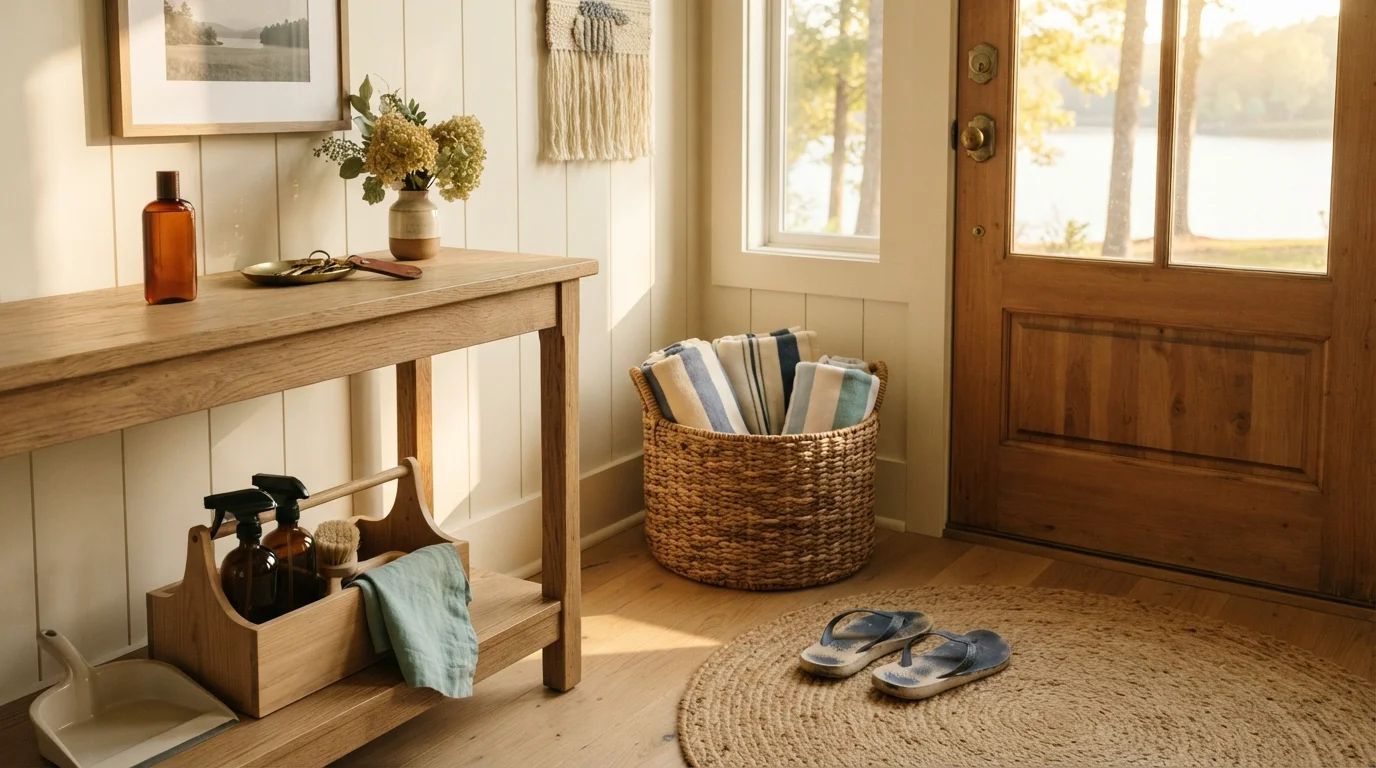


There are two winters in a North Georgia house, and only one of them gets written about.
The first is the hosting winter — Thanksgiving through New Year, a full house, the good towels out. We have covered that one already in getting a North Georgia home holiday-ready, and if guests are still on your calendar, start there instead.
This is the other winter. January and February. The guests have gone home, the decorations are boxed, nobody is coming, and the house has been sealed shut for two months with the heat running. It is the least glamorous stretch of the year and the one where a house quietly gets worse — which makes it, counterintuitively, the best cleaning window you get.
One boundary before we start: everything below assumes a house somebody is living in. A lake place that sits empty through the winter has a different problem — freeze risk and trapped damp rather than recirculated dust — and that plan is in winterizing a Lake Lanier home.
Why a closed house gets dustier
This is the part most winter cleaning checklists skip, and it explains nearly everything else on the list.
From roughly November, your house stops exchanging air with the outdoors. The windows are shut, the doors stay closed, and a forced-air system begins recirculating the same indoor air for months at a stretch. Whatever is in that air — settled dust, pet dander, fabric fibers, the fine grit that drifts in on shoes — gets pulled through the returns and pushed back out of the registers rather than leaving the building.
Nothing new is arriving. The same material is being redistributed, endlessly. That is why a house can look dustier in January than it ever did in July, despite nobody opening a window to let anything in.
Dry air compounds it. Heating strips moisture out of indoor air, and dust in low humidity carries a static charge — so instead of settling politely on horizontal surfaces where a duster finds it, it clings to screens, television surrounds, lampshades, and vertical surfaces. The house is not dirtier so much as the dirt has moved somewhere less convenient.
The EPA’s indoor air quality guidance is worth reading on this, because it frames the whole problem correctly: indoor pollutant levels depend on how well a building brings in outdoor air and how effectively it removes what builds up inside. A sealed house in heating season is a building doing less of both.
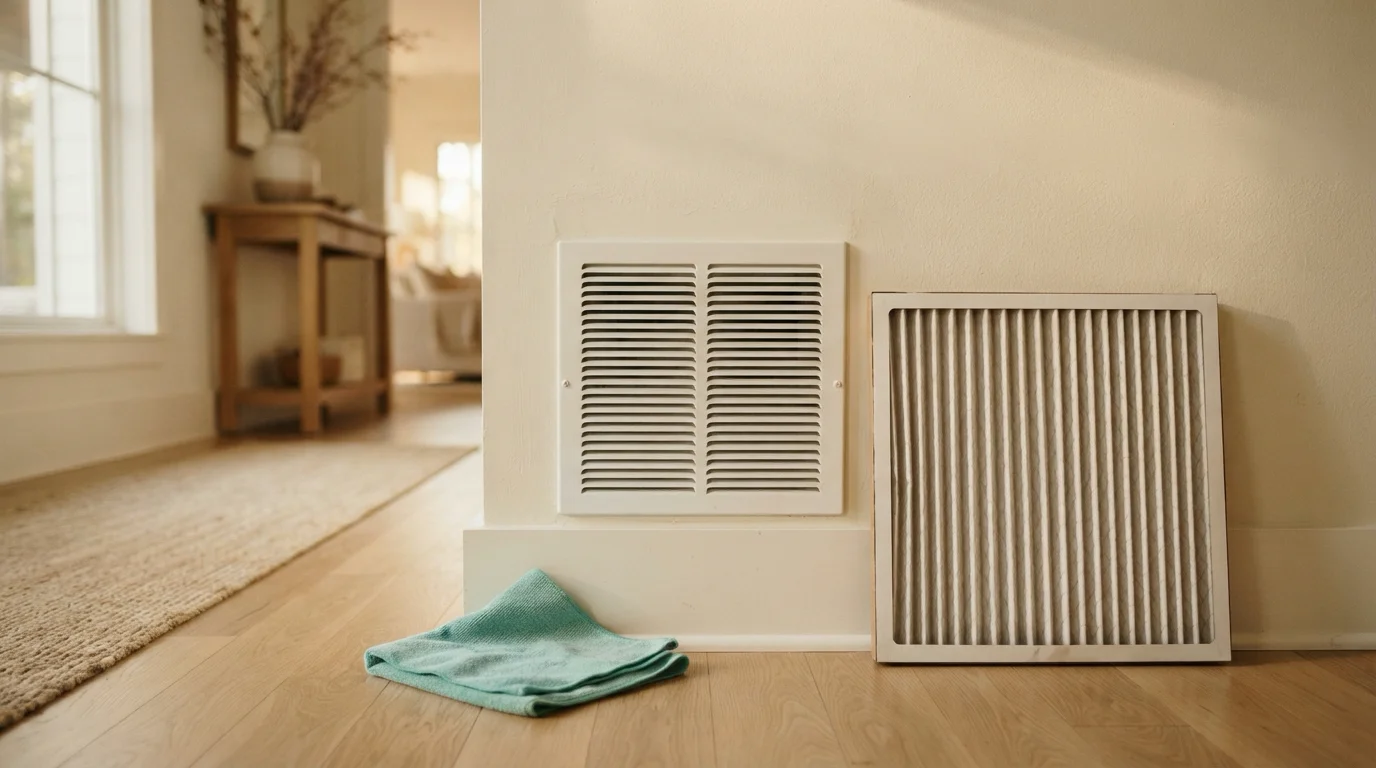
The systems moving your air
Three pieces of equipment decide how much of that recirculated dust you actually live with. All three are cleaning tasks, not maintenance tasks, and all three get skipped.
The HVAC filter
In heating season, the system runs far more hours than it does in April, so the filter loads far faster. A standard one-inch pleated filter in an occupied home is generally changed every 30 to 90 days; winter belongs at the short end of that range, and shorter again with pets or allergies in the house.
Check it monthly rather than trusting a date. Hold it up to a light — if light does not pass through, it has stopped being a filter and started being a restriction, which makes the system work harder to move less air.
One sequencing point that matters: change the filter before you clean, not after. Dusting and vacuuming put material into the air, and a fresh filter is what catches it.
The vents and returns
Supply registers get wiped occasionally. The return grille almost never does, and it is the dirtiest air fitting in the house — every cubic foot of air the system moves passes through it.
Vacuum both with a brush attachment, then wipe them down. If the register blades have visible buildup, that buildup is sitting directly in your airflow.
The humidifier
This is the one to take seriously. A humidifier holds standing water at room temperature, which is precisely the condition microbial growth prefers, and a neglected unit disperses whatever is growing in the tank into the room as fine mist.
The EPA’s indoor air guidance is direct: humidifiers need regular cleaning and frequent water changes. Practically, that means emptying and drying the tank between uses rather than topping it off, and cleaning it on the manual’s schedule rather than once in March when you put it away.
While you are at it, read the humidity. Heating season usually pulls a house too dry — which is what drives the static — but closed rooms, closets, and under-sink cabinets can run the other way. The EPA’s guide to mold, moisture and your home puts the target below 60 percent relative humidity and ideally between 30 and 50, with anything damp dried within 24 to 48 hours. Both ends of that range are worth knowing in winter, because a house can be too dry in the living room and too damp in the laundry closet on the same afternoon.
The winter cleaning checklist
With the systems handled, the rooms are straightforward. Work top-down, because winter dust has had months to settle high.
- Ceiling fans and light fixtures. Blades collect a surprising load over a sealed season, and reversing a fan for winter throws all of it into the room.
- The tops of things. Frame tops, cabinet tops, the upper shelf nobody reaches. This is where a closed house stores its dust.
- Screens and static-catchers. Televisions, monitors, and lampshades hold clinging dust in dry air. A slightly damp microfiber lifts it; a dry cloth in low humidity mostly relocates the charge.
- Baseboards and floor edges. Grit migrates to edges and stays there, and it is abrasive underfoot all winter.
- Bedding, properly. Launder the bedding along with the blankets and throws that came out for the season, and vacuum the mattress while the bed is stripped. A sealed bedroom concentrates whatever bedding sheds.
- Upholstery. Vacuum the sofas and chairs that have absorbed an entire indoor season, including under the cushions.
- Window tracks and sills. Condensation collects in the tracks through winter, and that damp plus dust becomes grime that is far harder to remove in March.
- High-touch points. Switch plates, handles, remotes, and railings. Disinfect them properly during the months a household shares more air than usual.
For the entry, one note rather than a section: winter tracks in the most abrasive material of any season, and the fix is the same entry discipline that carries the hosting months — which we covered in the holiday post. Wash the mats, clear the thresholds, and clean the first ten feet of floor properly.

Why January beats April for the deep clean
Spring cleaning is a tradition rather than a strategy. January has the better argument.
The house is empty of guests. The decorations are coming down anyway, which means the shelves, mantels, and surfaces are already clear — and a deep clean of a cleared room is a fundamentally different job from a deep clean of a decorated one. Nobody wants to be outside. And finishing the deep work now resets the baseline before pollen season, rather than starting it in the middle of the worst weeks of the year.
That last point matters more in North Georgia than almost anywhere. Our spring pollen season guide covers what arrives in March; a house that went into it already reset has a far easier spring than a house trying to do both jobs at once.
If you are weighing whether this is a deep clean or just a thorough regular visit, our comparison of recurring cleaning versus deep cleaning lays out which one a given house actually needs — and if you want the reset without committing to a schedule, a one-time cleaning covers it. And if you want the room-by-room task list rather than the winter-specific one, the cleaning checklist tool has it.
What a winter deep clean includes — and what it does not
Worth being plain about scope, because winter is when people ask.
A deep clean covers behind the appliances, grout lines, window tracks, blinds, light fixtures, and door frames. The inside of the oven, the inside of the refrigerator, interior window glass, and baseboard scrubbing are add-ons you name when you book rather than assume are included.
Our work is interior-focused. A light surface tidy of a porch or screened room is possible while the team is on site, but no deep or specialized exterior cleaning is offered — which in practice is the right division of labor in January anyway.
The products are chosen to be safe for children, pets, and Lake Lanier’s environment, which matters more in the months when the windows stay shut and everything you use stays in the air with you.
Booking the January reset
The practical advice: get the filter changed and the humidifier cleaned this week regardless of what else happens, because those two are doing the most work and taking the least attention.
For the rest, the quiet stretch after the holidays is the easiest cleaning window of the year, and it is also the least contested one on our calendar. If you would like the January reset handled by the same small, dedicated team rather than added to your own list, get in touch — or see how a steady recurring schedule keeps the sealed months from compounding in the first place.