
Choosing a Commercial Cleaner in Gainesville: What Local Businesses Should Know
Whether you're an office manager evaluating providers, a small business owner deciding how often to clean, or a property manager preparing a commercial space, this guide covers the standards, costs, and decisions that shape every commercial cleaning program.

- 1. What Counts as Commercial Cleaning
- 2. The Commercial Sectors We Serve
- 3. Why Commercial Differs from Residential
- 4. Cleaning Standards by Industry
- 5. How to Choose a Commercial Cleaning Provider
- 6. How Often Should You Clean?
- 7. The ROI of a Clean Workplace
- 8. Pricing: What Drives Commercial Cleaning Costs
- 9. Contracts vs. No-Contract
- 10. Lake Lanier Regional Factors
- 11. DIY vs. Professional Decision Framework
- 12. Common Questions
- 13. Find the Right Service for Your Business
What Counts as Commercial Cleaning
"Commercial cleaning" is a broad umbrella. In practice, it covers any professional cleaning of a non-residential space — offices, retail storefronts, small business locations, light industrial spaces, and the common areas of mixed-use buildings.
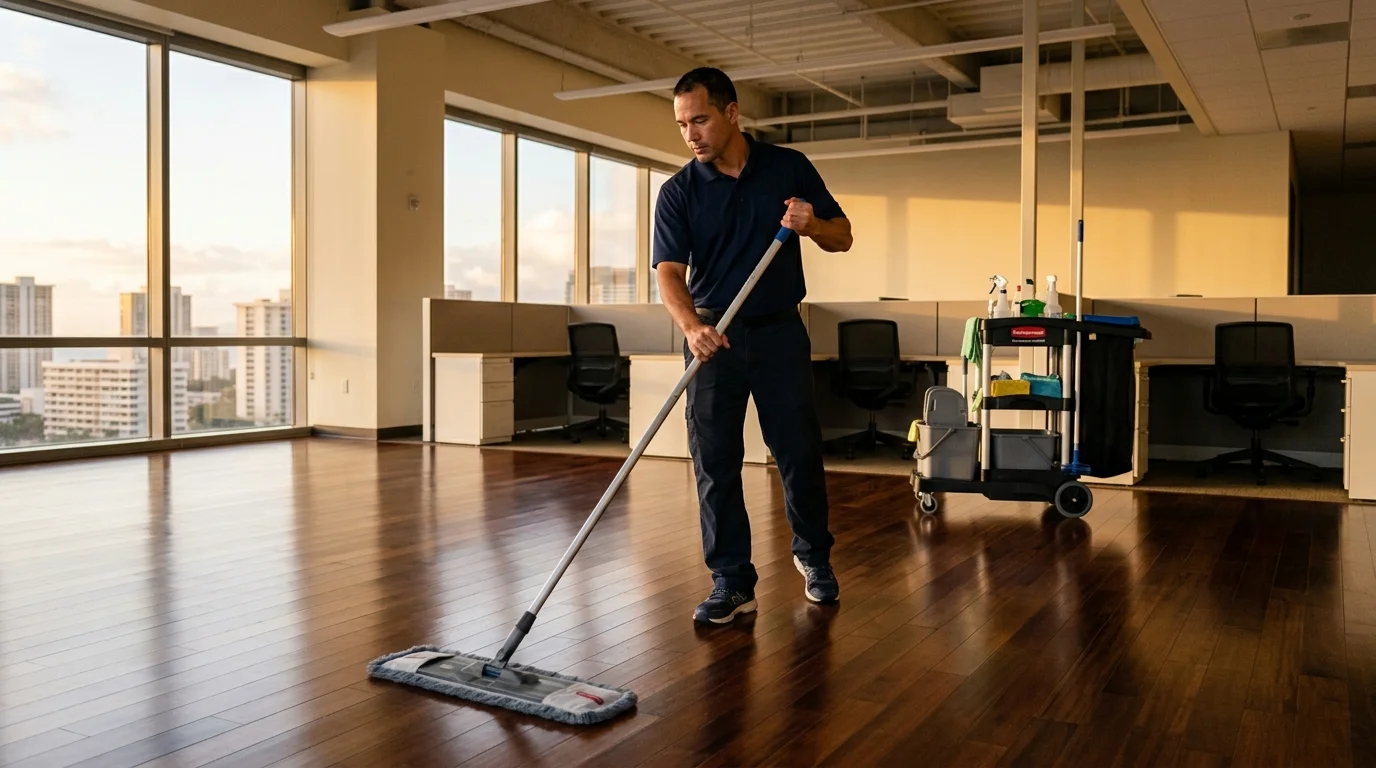
The work breaks into two main categories. Recurring janitorial is the steady rhythm — daily, weekly, or biweekly visits that handle restrooms, trash, floors, surfaces, and restocking. Periodic and one-off services cover the bigger work that doesn't fit a weekly schedule: deep floor care, window washing, post-event cleanups, post-renovation work, or seasonal resets.
Most businesses end up using both. The recurring schedule keeps the space presentable for customers and staff; the periodic work handles what daily cleaning can't reach. A good provider quotes each separately so you can scale up or down as your needs change.
This guide walks through how to think about commercial cleaning as a whole — what the sectors look like, what drives cost, how often to clean, and how to choose the right provider for your business in the Gainesville and Lake Lanier area.
The Commercial Sectors We Serve
Different commercial spaces have different cleaning needs. Here's how the most common categories break down for businesses in our area.
Offices
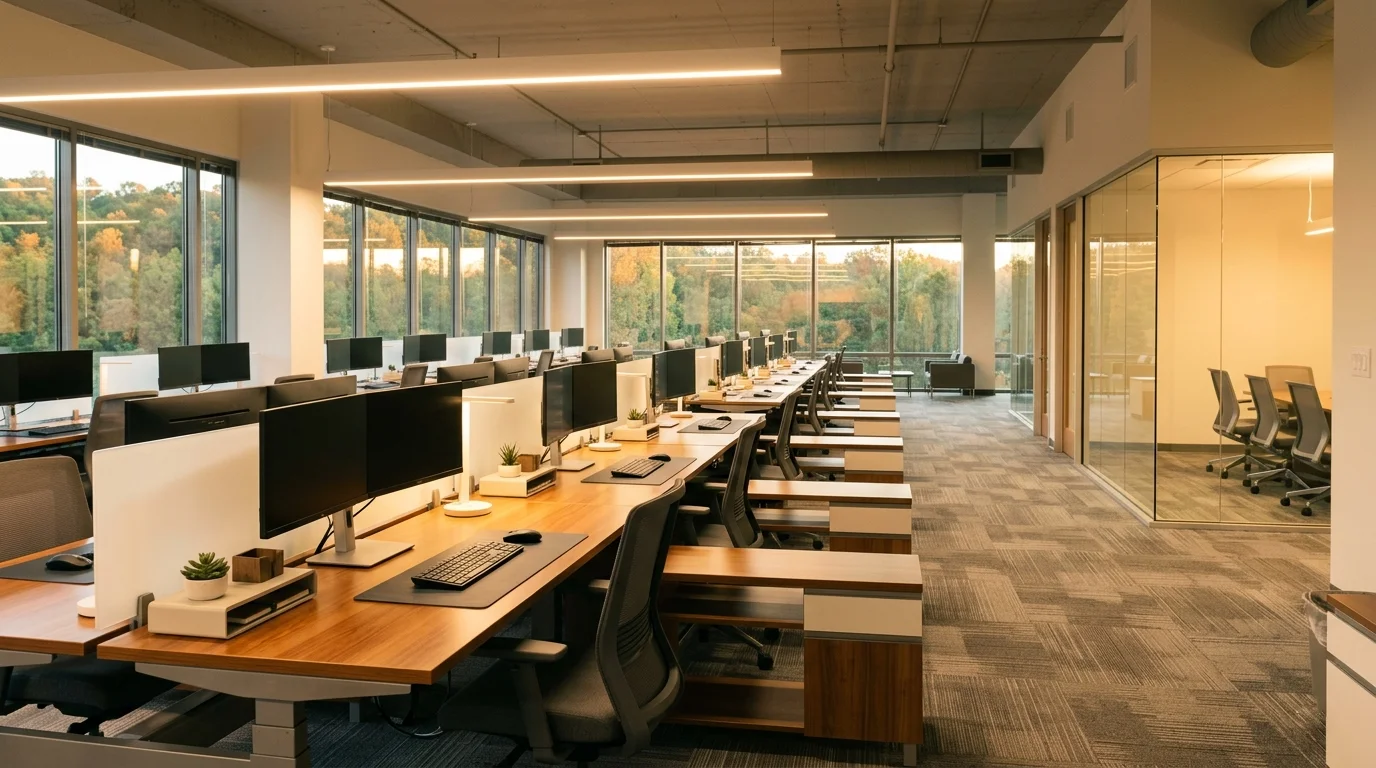
The largest category by far. Workstations, restrooms, common areas, conference rooms, and break rooms — handled mostly after-hours so the team arrives to a fresh space. Office cleaning is where most of our commercial clients start, and it's the focus of our office and janitorial services.
Retail and Showrooms
Customer-facing spaces where cleanliness directly shapes purchasing decisions. Floors and entryways take heavier wear, glass and fingerprints need constant attention, and restrooms (where provided) reflect on the brand. Most retail cleaning happens early-morning or late-evening to fit around store hours.
Small Business and Service Storefronts
Salons, studios, professional offices (legal, accounting, real estate), and other small business locations. Often a single space or small suite. The work is usually weekly or biweekly, scaled to the storefront's foot traffic.
Post-Renovation Commercial Spaces
When a business renovates — new buildout, expansion, or remodel — the post-construction clean is its own service. Drywall dust, paint, and adhesive residue require HEPA equipment and specialty products. We handle this through our post-construction cleaning service, separate from recurring janitorial.
Specialty environments like medical practices, food service, and industrial facilities have additional regulatory requirements (OSHA, HIPAA, FDA) that go beyond general commercial cleaning. We focus on the office, retail, and small business categories above where our boutique-level approach delivers the most value.
Why Commercial Differs from Residential Cleaning
On the surface, both involve dusting, vacuuming, restrooms, and trash. The differences become clear once you look at how the work is structured.
Traffic volume
A home of four people generates a predictable amount of mess. An office of forty generates ten times the foot traffic in restrooms, ten times the trash, and ten times the surface contact on door handles, light switches, and shared equipment. Cleaning frequency and product strength both have to scale to match.
Liability and standards
In a home, "clean enough" is judged by the people who live there. In a business, it's judged by every customer, employee, vendor, inspector, and visitor who walks through the door. A slip-and-fall on a wet floor, a complaint about a restroom, or visible grime in a customer area carries real liability — so commercial cleaning programs include more documentation, more consistency, and more attention to high-touch surfaces.
Scheduling constraints
Residential cleaning typically happens during weekday daytime hours when residents are at work. Commercial cleaning has to fit around your business hours — often after hours, before opening, or on weekends. The provider you hire needs the staffing flexibility to work when your space is empty.
Cross-contamination protocols
Restrooms, kitchens, and customer areas have to be cleaned with separate, color-coded supplies and equipment to prevent cross-contamination. This is standard professional practice in commercial settings — and a clear differentiator from a home cleaning service that occasionally takes commercial work.
If you're hiring a residential cleaner to handle your office because they're already cleaning your home, ask how they handle these structural differences before you commit.
Cleaning Standards by Industry
What "clean enough" looks like varies by space type. Here's a quick framework by sector.
Offices
- Restrooms cleaned and restocked at least daily in higher-traffic offices, 2–3× weekly in smaller ones
- High-touch surfaces (door handles, light switches, shared keyboards) wiped each visit
- Trash and recycling removed each visit
- Floors vacuumed/mopped on a regular cycle, with quarterly deep treatment
- Glass partitions and entry windows kept fingerprint-free
Retail
- Customer-facing entry, glass, and floors prioritized — these form the first impression
- Fitting rooms, checkout areas, and customer restrooms cleaned and reset before opening
- Display surfaces dusted regularly (including merchandise shelving)
- Floor care scheduled around store traffic patterns (early morning is ideal)
For a complete daily/weekly/monthly breakdown specific to retail, see our retail cleaning checklist for storefronts.
Small Business / Storefront
- Reception/waiting areas cleaned and reset before opening
- Restrooms restocked and sanitized to public-facing standards
- Glass entry doors and signage areas kept clean
- Cleaning frequency matched to weekly client volume
A good provider will tour your space and propose a frequency and scope that match the standards above. If their proposal feels generic — or doesn't reflect what your industry actually requires — that's worth flagging before you sign on.

How to Choose a Commercial Cleaning Provider
Choosing a commercial cleaning provider is more consequential than most business owners realize. The right provider becomes invisible — your space stays consistently presentable and your team stops thinking about it. The wrong provider creates a constant low-grade problem: missed visits, complaints, employee frustration, and the eventual need to start over.
A few essentials worth verifying before you sign:
- License, insurance, and bonding. Non-negotiable. Ask for proof, not a verbal yes.
- Local references. Can they name two or three current clients in our area you could call?
- Same-team consistency. Will the same crew clean your space each visit, or do they rotate? Rotating crews mean inconsistent quality.
- Walkthrough quality. A provider who walks your space and asks specific questions (high-traffic areas, your top frustrations, special requests) will outperform one who quotes from square footage alone.
- Communication and accountability. When something goes wrong — and eventually something will — how do they handle it? A good provider has a clear process for callbacks, complaints, and adjustments.
- No-contract flexibility. Multi-year contracts protect the cleaner, not you. The best providers earn ongoing business through results, not paperwork.
For a deeper walkthrough of what to look for (and what red flags should kill the deal), our blog post Choosing a Commercial Cleaning Company in North Georgia covers the full vetting framework. If you're already under contract with a provider you want to leave, see our companion guide on switching commercial cleaning companies without disruption.
How Often Should Your Business Be Cleaned?
Cleaning frequency is the single biggest cost lever in a commercial cleaning program — and the one most businesses miscalibrate. Too often, and you're paying for work the space doesn't need. Too rarely, and the cumulative grime compounds into a deep-clean problem that costs more to fix than the recurring service would have prevented.
A rough framework by business type:
- Daily: high-traffic offices (50+ employees), public-facing service businesses, retail with food, customer-heavy storefronts
- 2–3× per week: mid-size offices (15–50 employees), small retail, professional services with steady client traffic
- Weekly: small offices (under 15 employees), storefronts with light foot traffic, suite-style professional offices
- Biweekly: small one-person professional offices (legal, accounting), studios, low-traffic showrooms
For a more detailed breakdown by business type — including pricing benchmarks for our area — see our blog post How Often Should an Office Be Professionally Cleaned?.
Most businesses start at a frequency they think they need, then adjust within the first 60 days based on what the space actually demands. A good provider will recommend an adjustment before you ask.
The ROI of a Clean Workplace
Commercial cleaning is often categorized as overhead — a cost line, not an investment. The research suggests otherwise. Studies on workplace cleanliness consistently link clean environments to:
- Higher employee productivity — fewer distractions, better focus, less time spent navigating clutter
- Reduced sick days — high-touch surface sanitization measurably reduces seasonal illness transmission
- Stronger client and vendor impressions — first impressions are largely visual, and cleanliness is one of the loudest signals
- Better employee morale and retention — staff notice when their workspace is taken seriously
For a deeper look at the productivity and ROI research, see our blog post How a Clean Office Boosts Productivity.
The point isn't that cleaning is free. The point is that for most businesses, the recurring cost of professional cleaning is recovered several times over in productivity, client perception, and reduced sick-day burden.
Pricing: What Drives Commercial Cleaning Costs
Commercial cleaning is almost always quoted per visit, not per hour. The visit price is built from a combination of factors:
- Square footage — the largest single driver
- Frequency — daily and weekly visits price differently per visit (higher frequency usually means lower per-visit cost)
- Scope — basic janitorial (trash, restroom, surfaces) vs. expanded scope (window cleaning, deep floor care, restocking)
- Restroom count — restrooms are the most labor-intensive area per square foot
- After-hours or weekend scheduling — typically a small premium over standard daytime work
- Specialty work — quoted separately (post-construction, post-event, periodic deep cleans)
For our area, basic recurring office cleaning typically falls in a per-square-foot range that varies with frequency and scope. Our blog post on cleaning frequency includes pricing benchmarks for North Georgia.
If a quote is significantly below the market range, look closely at what's included before you sign. Common shortcuts that lower the price: skipping restrooms after the first visit, rotating skeleton crews instead of consistent teams, and using lower-grade supplies that leave residue or odor. The cheapest quote usually isn't the cheapest service over twelve months.
Contracts vs. No-Contract: What's Right for Your Business?
Most large national janitorial companies require multi-year contracts. Most boutique providers don't. There's a real choice here, and it's worth thinking through.
When a contract makes sense
If you operate a large facility with predictable needs (50,000+ sq ft, multiple buildings, complex compliance requirements), a multi-year contract can lock in pricing and ensure dedicated staffing. National providers structure their pricing around those commitments.
When no-contract makes sense
For most small and mid-size businesses — offices under 20,000 sq ft, retail, professional services — a no-contract relationship gives you more leverage. If quality slips, you can move on. If your needs change (downsize, expand, change locations), you can adjust without negotiating an exit. And the provider has a permanent incentive to keep earning the work.
We operate on a no-contract basis. You can adjust your schedule, add specialty services, or pause cleaning at any time. We earn your repeat business through consistent results, not paperwork.
Lake Lanier Regional Factors That Affect Commercial Cleaning
North Georgia's climate creates specific commercial cleaning challenges that providers from outside our area often underestimate.
Spring pollen season
From late February through April, pollen coats every horizontal surface — entryway floors, window sills, exterior glass, and any tracked-in dust. Commercial cleaning programs in our area typically increase entry-mat cleaning frequency and add exterior glass attention during pollen season. If your provider doesn't adjust, your space will look perpetually dingy until the season ends.
Red Georgia clay
Tracked into commercial entryways, especially during wet weather, red clay stains light flooring, mats, and carpeting if it isn't addressed quickly. Aggressive entry-mat treatment and timely floor care prevents permanent staining.
Humidity
Summer humidity affects break-room, restroom, and storage area cleanliness. Mold growth is faster, soft surfaces hold odor longer, and restroom restocking becomes more frequent. A summer-aware cleaning program is materially different from a winter one.
Seasonal foot traffic patterns
Many North Georgia businesses see strong seasonal swings — Lake Lanier tourism in the summer, holiday retail surges, year-end professional services rushes. A good provider will scale their frequency and scope with your business calendar, not lock you into a flat year-round schedule.
Local knowledge of these conditions is one of the clearest advantages of working with a North Georgia–based provider over a national chain.
DIY vs. Professional: A Decision Framework
Smaller businesses often start with in-house cleaning — a staff member who handles the basics, or a rotation among the team. There's a point where that stops working.
In-House Often Works When...
- You're under 5 employees in a small space
- Customer foot traffic is minimal
- Cleaning is mostly trash and surface wipe-downs
- The team genuinely doesn't mind handling it
Professional Cleaning Pays Off When...
- You have public-facing customer areas
- Restrooms get heavy use
- Staff time spent cleaning has higher-value alternatives
- Cleanliness affects client perception or sales
- Compliance, safety, or liability is a factor
The math usually tips toward professional once cleaning takes more than a few hours per week of staff time, or once your space starts hosting customers regularly. Your team's billable or productive hours are almost always worth more than the cleaning rate.
A practical hybrid: keep daily tidying in-house (kitchen rinses, desk surfaces, coffee station), and bring in a professional weekly or biweekly for the structural work (restrooms, floors, glass, deep surfaces).
Common Questions About Commercial Cleaning
Answers to the most common questions business owners ask when scoping a commercial cleaning program.
What's the difference between commercial cleaning and janitorial services?
In practice, the terms overlap heavily — both describe professional cleaning of business spaces. The technical distinction is timing and scope. "Janitorial" usually refers to the recurring maintenance work that happens daily or weekly (trash, restrooms, floors, restocking). "Commercial cleaning" can include those same tasks plus larger periodic work like deep floor care, window washing, post-event cleanup, or post-construction. When choosing a provider, the more useful question isn't the label — it's whether the scope and frequency they propose match what your space actually needs.
How long does it take to clean a typical office?
It depends on square footage, traffic volume, and scope. As a rough benchmark: a 2,000 sq ft office with light desk/restroom/floor work takes 1.5–2.5 hours per visit; a 5,000 sq ft mixed-use space with restrooms and a break room runs 3–4 hours; a 10,000+ sq ft facility with multiple restrooms and high-traffic common areas typically needs 5+ hours. After the first few visits, a good provider learns your space and tightens the time estimate.
Do you clean during business hours or after hours?
Both — the right answer depends on your operations. After-hours (evenings or early mornings) is most common for offices because it avoids disrupting work and lets cleaners move freely between spaces. Daytime cleaning works for small offices, retail with quiet hours, or shared workspaces where the visible presence of a cleaner is part of the trust signal. Some clients use a hybrid: heavy work after hours, light touch-up midday. Tell us how your space operates and we'll propose a schedule.
Can you handle both ongoing janitorial and one-off deep cleans?
Yes. Most commercial clients combine recurring service (the steady weekly or daily rhythm) with periodic deeper work — quarterly carpet care, semi-annual window cleaning, post-event cleanups, or seasonal resets. We'll quote each separately so you know exactly what you're paying for, and there's no commitment that locks you into one schedule.
What about post-renovation cleanup for a commercial space?
Post-construction cleaning for commercial spaces is its own service — it requires HEPA-filtered equipment and specialty products to handle drywall dust, paint, and adhesive residue without damaging finishes. If your business is renovating an office, retail space, or restaurant, schedule the post-construction clean separately from your routine janitorial service, and ideally before staff or customers return. See our post-construction cleaning service for details.
Find the Right Service for Your Business
Two services cover most commercial cleaning needs in our area. Both share our 100% Boutique Cleaning Guarantee — what differs is the scope, the equipment, and the cadence.
Office & Janitorial Services
For offices, retail, and small business storefronts. Recurring janitorial with flexible after-hours scheduling and no contracts.
View Service DetailsPost-Construction Cleaning
For commercial buildouts, expansions, and remodels. HEPA-filtered, multi-pass cleanup that handles drywall dust, paint, and adhesive residue.
View Service DetailsNot sure which one fits? Tell us about your space and we'll recommend the right approach.
Mara Guilford
Owner & Founder, Lanier Pristine
Mara has been cleaning homes and businesses for 20+ years, across the Lake Lanier region since 2020. She founded Lanier Pristine on the principle that the same boutique-level attention that wins residential clients deserves to extend to the offices, retail spaces, and small businesses that anchor our local community.
Learn more about Mara