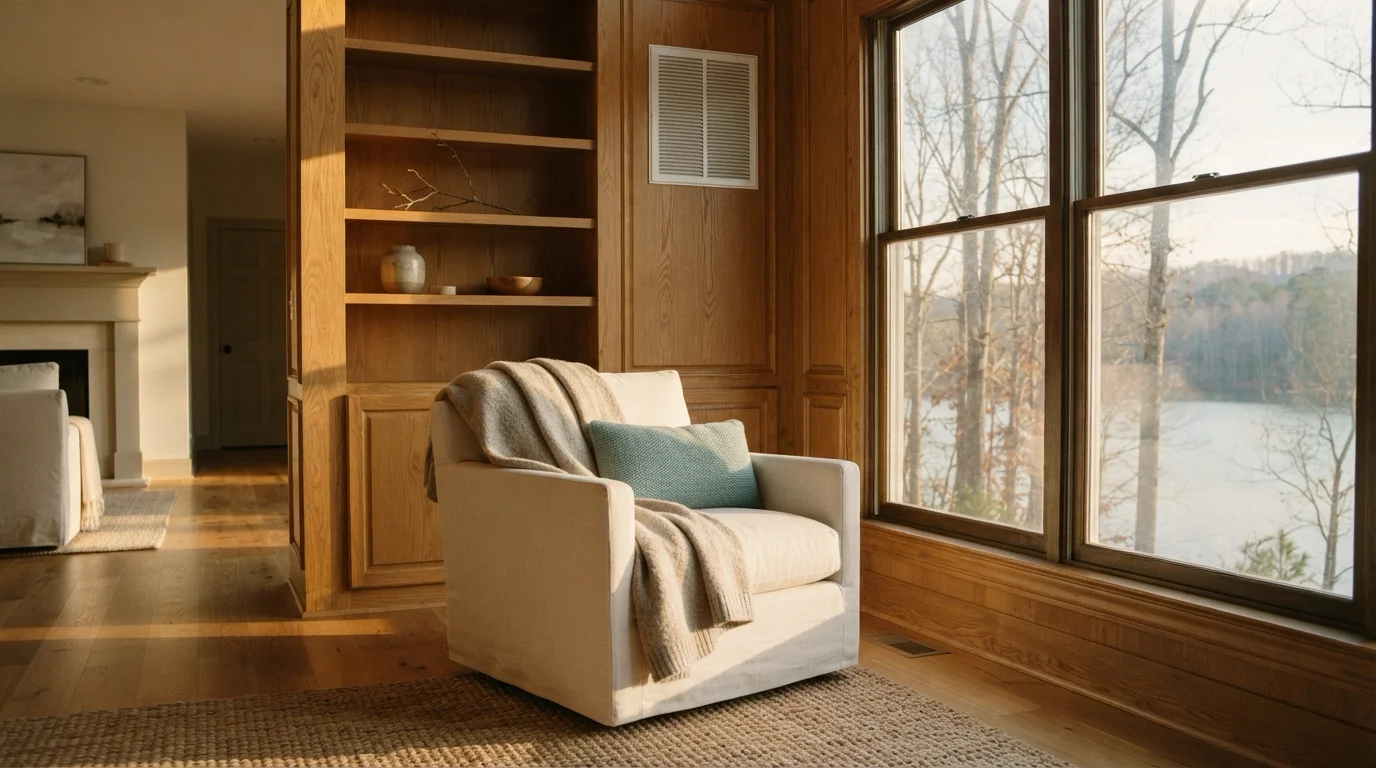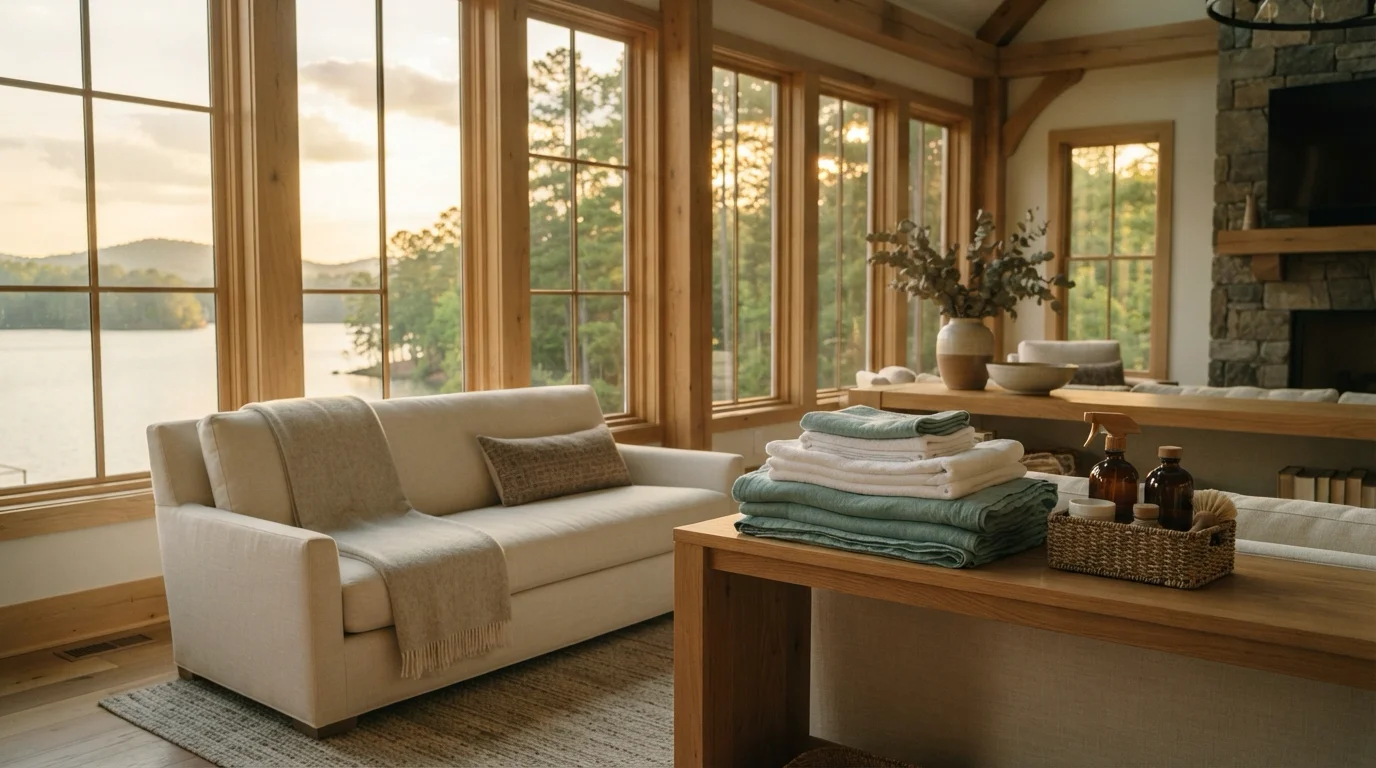

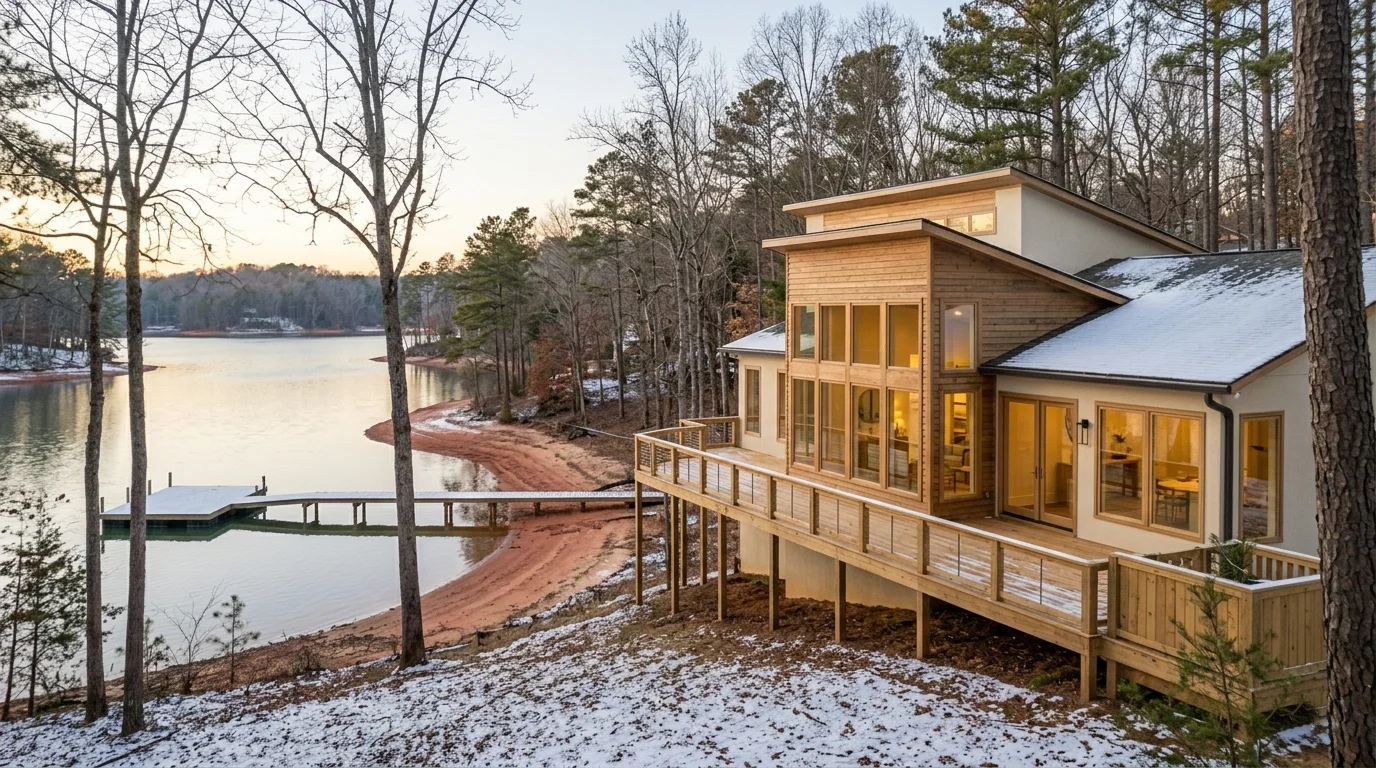
The first hard freeze on Lake Lanier doesn’t announce itself.
One still winter night the temperature drops below 28°F, a thin skin of ice forms along the cove, and somewhere in a dark, empty lake house an exposed pipe begins to count down. Nobody is there to hear the furnace cycle — or fail to. And on Lake Lanier that night can come early: the first freeze arrives in November, well before deep winter sets in.
That’s the winter every second-home owner is quietly insuring against — the part the fall close-up left for now.
Short answer: Winterizing a Lake Lanier home is three jobs at once — freeze protection, the vacant-home routine, and a clean, dry interior. North Georgia gets hard freezes (NOAA calls a “hard freeze” 28°F or colder, and Gainesville’s January average low sits near 33°F), so a home that sits empty needs homeowner freeze steps (drip faucets in a cold snap, disconnect hoses, hold the thermostat warm enough), humidity control in a cold closed house, and a dry interior so it opens clean in spring. Meanwhile the U.S. Army Corps of Engineers draws the lake toward its annual low for flood storage. Here’s the owner’s winter playbook.
After 20+ years cleaning North Georgia homes — Lake Lanier properties chief among them since 2020 — I can tell you the difference between a house that opens fresh in April and one that opens with a burst pipe and a musty closet is decided in December and January, by an owner who is somewhere else. This is the winter bookend to closing the house — all about what happens when no one’s watching.
This is the winter work the fall close-up deferred
Our guide to closing the lake house in the fall stopped short on purpose: actual mechanical winterizing — water systems, pipes, and the closed-home routine — is its own job, “one we’ll cover in the winter work.” This is that work. So I won’t re-tread the fall transition — ragweed, leaf load, the on-site maintenance pass. What follows picks up after the house is closed: the deep-winter protocol for a home that now has to survive hard freezes, weeks of still air, and an owner who’s two hours — or two states — away.
One framing note. Everything below about pipes and faucets is ordinary homeowner home-care — the same drip-the-faucet, disconnect-the-hose steps the Red Cross publishes. Anything involving your actual water system, water heater, or plumbing fixtures is a licensed plumber’s job, not a cleaning crew’s. I’m a cleaner; I’ll tell you where my lane ends.
What a Lake Lanier home faces in deep winter
North Georgia winters are not Florida’s. We get freezing nights, hard freezes, and the occasional ice event, and the lake doesn’t soften the cold the way people assume. By NOAA’s definition, a “hard freeze” is 28°F or colder — cold enough to threaten exposed plumbing and stress a house that isn’t being lived in. The 1991–2020 climate normals put Gainesville’s January average low near 33°F, so sub-freezing and hard-freeze nights are routine across the heart of winter. And the cold starts early: the first fall freeze arrives in November — frost is near-certain in Gainesville by November 22 (NOAA 1991–2020, the figure the fall post cited) — so by the time deep winter sets in, the house has already weathered weeks of freezing nights.
A house that’s lived in shrugs this off — doors open, faucets run, heat cycles, someone notices the cold spot. A closed lake house has none of that. It sits sealed and still through every freeze and every damp warm-up between. Two risks come due in that stillness: water that can freeze and burst, and air that goes stale and damp. The rest of this guide is those two problems and the dry interior that ties them together.
Freeze protection: the homeowner home-care steps
Frozen, bursting pipes are the catastrophic winter failure — the one that turns an empty house into a flooded one. The good news: the protective steps are simple, and the American Red Cross lays them out clearly. Before and during very cold weather:
- Let cold water drip from faucets served by exposed pipes. A trickle of moving water is far harder to freeze than a still column. Pipes are commonly cited as at risk around 20°F or below, especially on exposed runs — so the drip is a cold-snap move, not an all-winter one.
- Disconnect and drain garden hoses; shut off and drain outdoor faucets. A hose left connected traps water that freezes back into the spigot and the wall behind it — one of the most common and most preventable freeze failures on a lake property, where hoses and dock-side spigots are everywhere.
- Insulate pipes in unheated areas. Crawlspaces, garages, and the under-house spaces common on a sloped lake lot are exactly where a hard freeze finds bare pipe.
- Keep the heat on, set steady. Don’t let an empty house go cold to save a few dollars on the gas bill — it’s the most expensive saving there is.
For a vacant home specifically, the home-insurance and energy guidance is consistent: hold the thermostat at a minimum of about 55°F (insurers commonly cite 55–60°F, echoed by the U.S. Department of Energy). That floor keeps the wall and floor cavities where plumbing runs safely above freezing even on a hard-freeze night. A smart thermostat you can watch from your phone earns its keep here — you catch a January heat outage from the couch at home, not from an April walk-through and a waterlogged ceiling. Anything beyond these steps — draining the system, blowing out lines, servicing the water heater — is a licensed plumber’s call, worth that conversation early for a home that sits truly empty all winter.
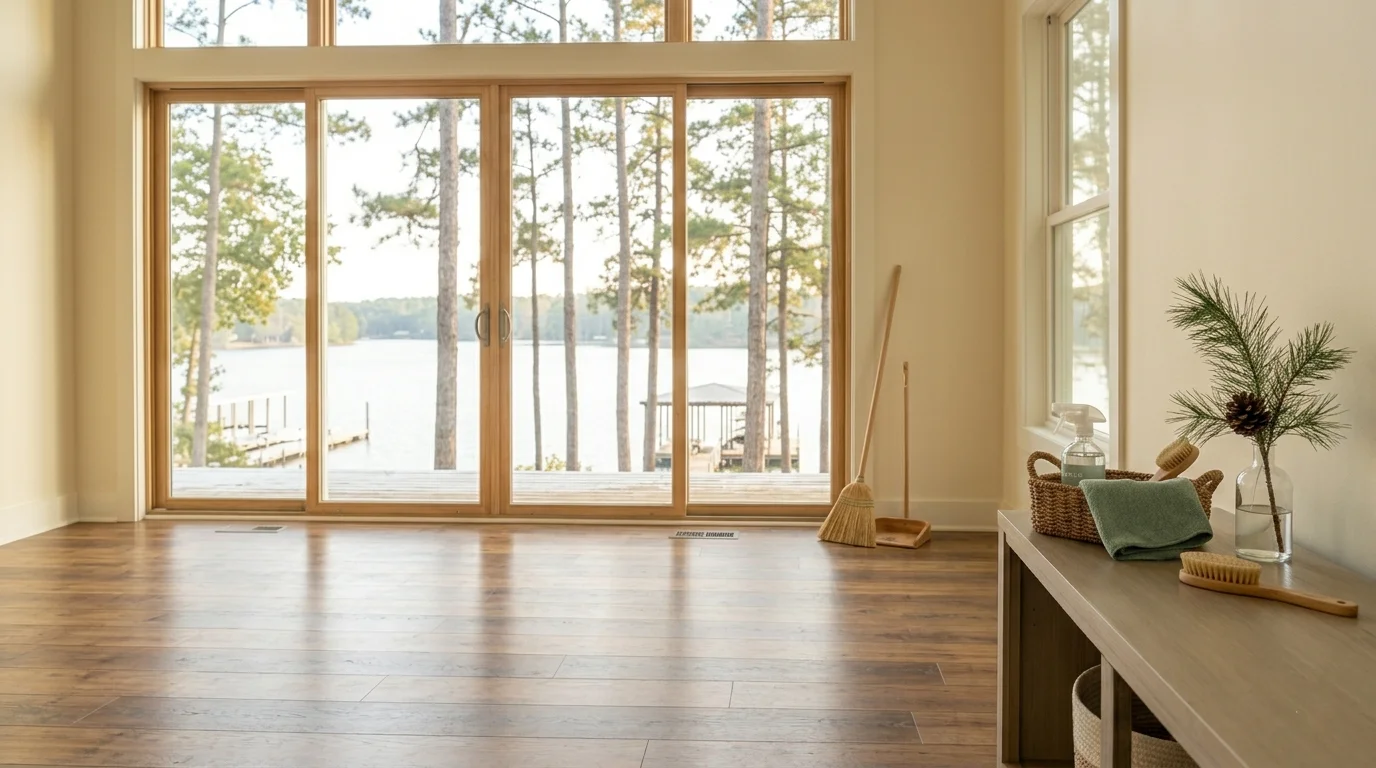
The vacant-home winter routine
Freeze protection keeps the water from destroying the house. The vacant-home routine keeps the house itself in good order through months of no one being there. Think of it as a short, repeatable rhythm rather than a one-time setup:
- Hold the climate control — don’t kill it. The same steady thermostat setting that protects your pipes also keeps the air moving so it never sits saturated. A house with the system off is one quietly composting its own humidity.
- Set up a check-in cadence. You, a neighbor, or a trusted service — someone should lay eyes on the house periodically, especially after a hard freeze or ice event. A leak caught in week one is a towel; in week six it’s a remodel.
- Watch the weather, not just the calendar. The drip-the-faucets step is triggered by a forecast — a cold snap heading toward the commonly cited 20°F mark — not by a date. A remote thermostat nudge matters most during a deep-cold stretch with the house empty.
The through-line: a vacant house has no human early-warning system, so you build one — a steady setting, a set of eyes, and a forecast you actually check. (The dampest zones — lower levels and lakeside closets — get their own plan next.)
Humidity and a clean, dry interior in a cold closed house
A heated, sealed winter house works against itself two ways at once — the genuinely winter-specific problem. The furnace dries the air toward parched even as the cold lakeside zones — lower-level closets, the band of wall against frozen ground — quietly go damp. You can over-dry the living space and grow mildew in the basement in the same week.
The EPA recommends keeping indoor relative humidity in roughly the 30–50% range (and below 60%) — a band that matters in both directions here. In damp warm-ups and against cool ground, the coldest zones climb back toward mold-friendly conditions; meanwhile winter heating can pull the living space so dry it irritates skin, eyes, nose, and throat. The goal isn’t “as dry as possible,” it’s steady and in range.
There’s a winter-only air-quality wrinkle, too. A closed house with little fresh-air exchange concentrates whatever gets generated indoors, and the EPA notes that burning almost anything — fireplaces, wood stoves, candles, cooking, fuel-fired heating — produces particulate matter. Over a holiday-week gathering that combustion load builds up in air that isn’t turning over, so vent combustion appliances outdoors and run range hoods and exhaust fans when the house is occupied.
The dry-the-house-and-prop-the-doors lock-up belongs to the fall close — our fall humidity plan covers that step. What’s left for deep winter is keeping the closed house in range across the months that follow:
- Manage the dehumidifier and absorbers through the whole season, not just at close-up. Powered units handle rooms with outlets; in far closets and corners, absorbers keep working unplugged, and across months of cold they fill and need swapping.
- If the house gets used, reset the combustion load. After a fireplace-and-cooking holiday week, the soot, ash, and kitchen residue shouldn’t sit sealed in until spring. A clean-out before you re-close is the difference between a fresh April and a smoky one.

Reading the winter lake
The water tells you what season the house is really in. The fall post covered the start of the drawdown — the waterline first pulling back. By deep winter that process has run its course: the lake is now at or near its annual low, with the most shoreline and dock structure of the year exposed. In a typical flood-control drawdown the Corps brings Lake Lanier toward roughly 1,060 ft, the bottom of its operating range, before spring rains refill it. (The fall post covers the mechanics — the 1,071-ft summer pool easing to the 1,070-ft winter target, and why the Corps holds that buffer.)
That exposed shoreline is the backdrop your closed house sits against until the spring fill — the deep, quiet bottom of the lake year, when your winterizing has to be holding.
What Lanier Pristine Does Differently
We treat the cold months as their own job, not a gap between the fall close and the spring open. The same small team that knows your home runs the winter-minded final clean, with HEPA-filtered vacuums and color-coded microfiber so the interior we leave behind is genuinely clean — not just tidy — before it sits sealed for months. Because it’s the same crew each visit, they remember where your house holds moisture, which lakeside closet goes musty first, and where the moisture absorbers earn their place. We’ll tell you plainly when a home needs a dehumidifier or a smart thermostat rather than one more scrub — and flag, in our own lane, when something looks like a job for your plumber. For an owner-occupied home that’s our recurring service or a one-time deep clean, done with eco-friendly products safe to leave behind in a closed house. If you rent the property, our lake house and rental cleaning covers the turnover side, and the heavier annual reset is its own distinct job — scope, timing, and booking math live in our guide to the off-season deep clean for Lake Lanier rentals, and if you’re hosting at the holidays, our pre-guest cleaning checklist carries the room-by-room timing.
Book the winter watch before the deep freeze
A winterized Lake Lanier home is one that’s been closed dry, set to hold heat and humidity through the cold, and checked on while you’re away — so it opens fresh in spring instead of opening a claim. The weeks no one’s there are when small problems become expensive ones.
If you’d like a team that treats the quiet months as the careful hand-off they are — a winter-ready final clean, a real humidity plan for the closed house, and eyes that know where your home holds trouble — reach out for a quote. We serve the full Lake Lanier corridor and set up the winter watch before the cold settles in. For the bigger picture, see our year-round seasonal cleaning guide; to plan the spring re-open, our off-season deep-clean guide covers the heavy reset.