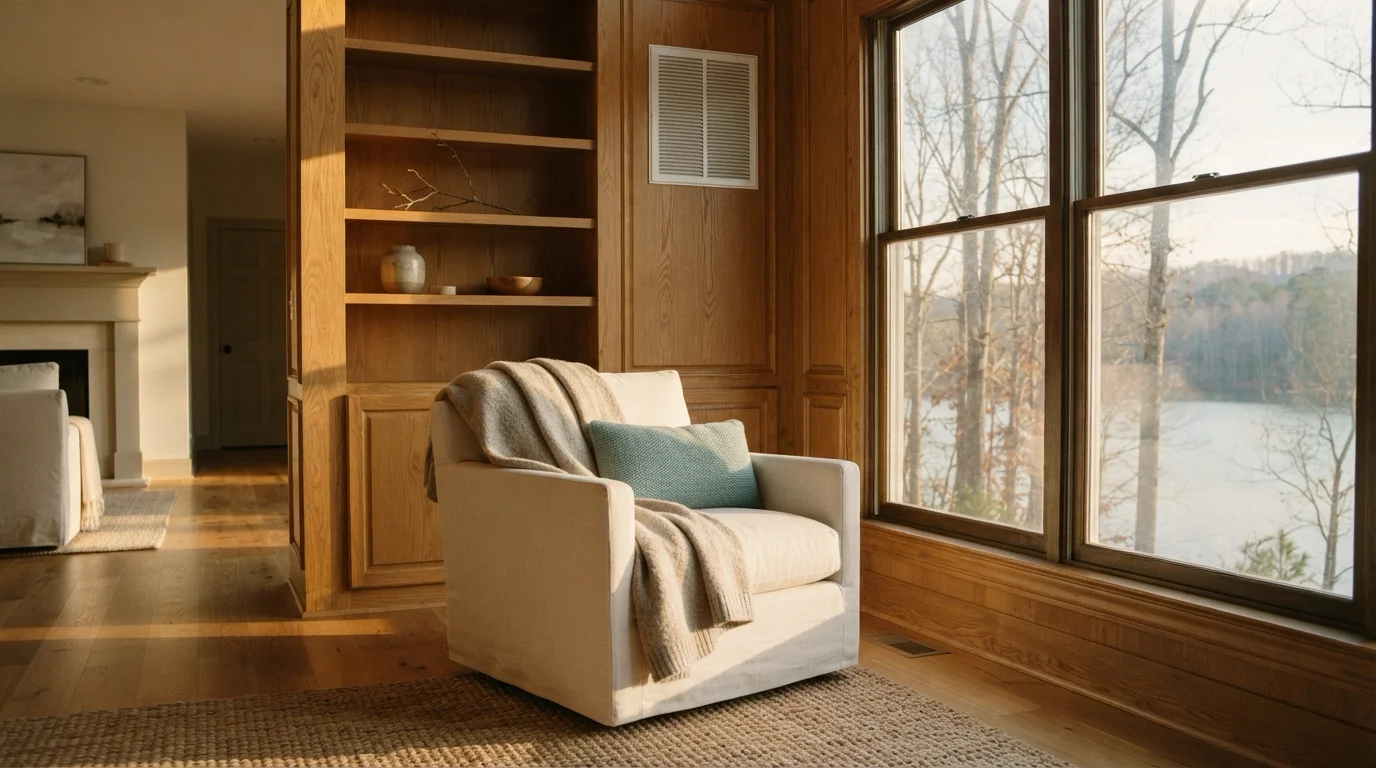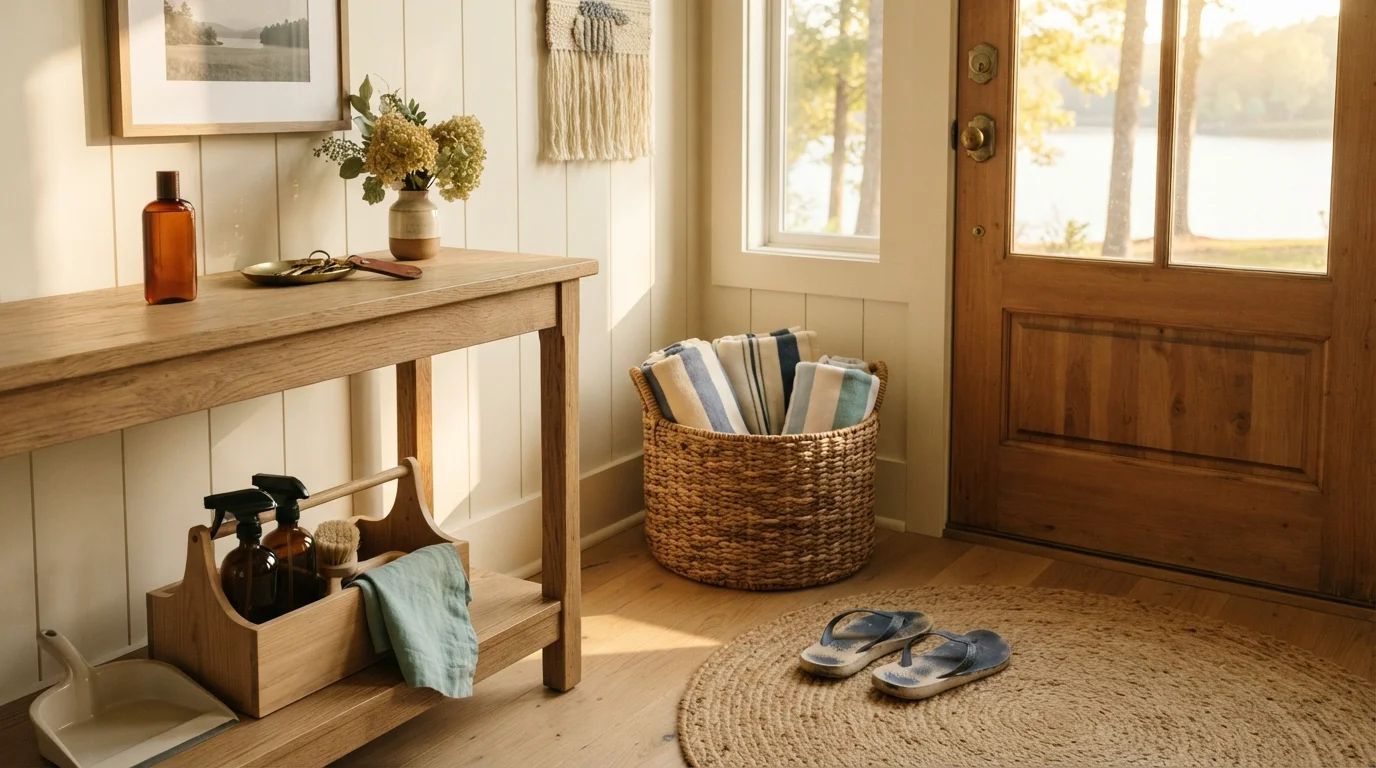


The first cars usually come up the driveway the week of Thanksgiving.
By then the boats are out of the water, the windows have been shut for weeks, and the house is running warm against the first real cold. It looks ready. But a sealed, heated North Georgia home in December is doing things to its own air that a summer house never does — and a holiday full of guests only adds to it.
Getting guest-ready is two jobs at once: the welcome, and the winter air underneath it.
Short answer: Holiday hosting in North Georgia runs from late November through New Year — Thanksgiving 2026 lands on November 26, with Christmas and New Year right behind (Old Farmer’s Almanac). To get a home guest-ready, focus the high-traffic and guest-facing zones, the guest bath and bedroom, and the kitchen for heavy cooking. But winter adds a layer the rest of the year doesn’t: a closed, force-heated house recirculates dust, and fireplaces, wood stoves, candles, and cooking all add particulate matter (EPA), while heating dries the air below the EPA’s recommended 30–50% humidity range. Book the pre-holiday reset in November or early December, then plan a post-holiday reset once the last guest leaves.
After 20+ years cleaning North Georgia homes — Lake Lanier properties chief among them since 2020 — I can tell you the homes that host well at the holidays aren’t the ones that scrub hardest the night before. They’re the ones reset before the season starts, so the only work left during a month of guests is keeping a clean baseline.
Holiday hosting is one long season, not one night
Most of the year, a host clean is a single event: guests come, you reset, you’re done. The holidays break that pattern.
Thanksgiving always falls in late November — Thursday, November 26 in 2026 — and the long weekend after it is one of the busiest gathering stretches of the year, with Christmas and New Year following in late December (Old Farmer’s Almanac). For a lot of North Georgia homes, that means overlapping waves of guests across five or six weeks, often with overnight stays.
For the generic, room-by-room host clean — the timed countdown from a week out to the hour before, where guests actually look versus what they never notice, and the one-hour triage if the doorbell’s about to ring — I’ll point you to our pre-guest cleaning checklist. That’s the season-agnostic playbook, and it holds for the holidays too. There’s no reason to rebuild it here.
What changes at the holidays is the winter layer on top of that checklist. So the rest of this is the part the checklist can’t be: the guest-facing priorities that matter most when the house is full and cold, the closed-house air reality, and the reset after.
The guest-facing zones that carry the holidays
When the house is full, the load concentrates in a few places. Spend your pre-holiday effort there.
The guest bath and guest bedroom. For which rooms to hit first and in what order, the pre-guest checklist already covers it. The winter-specific reason these rooms matter at the holidays is narrower: a closed, force-heated house lays a fine dust film on nightstands, fixtures, and headboards faster than an open-window summer ever does, and towels in sealed winter air have to actually smell fresh, not just sit folded. Reset these first and reset them thoroughly.

The high-traffic common zones. The entry, the main living area, the powder room near it. These take the most foot traffic during a gathering. In winter, the entry does double duty — it’s also where the season’s mud and grit come in (more on that below).
The kitchen, braced for heavy cooking. Holiday cooking is a different animal: ovens running for hours, the range hood working overtime, more grease and steam than any normal week. Going into the season, you want a kitchen that starts clean — degreased surfaces, a clear sink, an empty dishwasher ready for the load — because once cooking starts, you’re maintaining, not deep-cleaning. And the range hood matters more than people think in winter: the EPA lists cooking among the indoor sources that raise particulate matter, and emphasizes exhaust ventilation to move it outside (EPA). Run the hood while you cook; it keeps the closed house breathable.
The winter air no one talks about: a sealed, heated house
Here’s what separates a holiday clean from any other host clean. By the time guests arrive, your house has been closed up for weeks — and closed-up, heated houses concentrate what’s inside them.
One distinction first: this post is the occupied, heated, hosting house — forced-air recirculation, combustion soot, and dry-air comfort with people staying over. The other closed-house problem — a vacant lake home where trapped humidity turns musty and risks mold over a long empty stretch — is a different mechanism, and we cover that plan in the fall off-season prep post. If your house sits empty between visits, start there; the rest of this section assumes a heated house full of guests.
Forced-air heat circulates dust. Once the windows shut for the season, your HVAC recirculates the same indoor air for months. Whatever’s in it — settled dust, pet dander, the fine grit that drifts in — gets pushed back into the air and resettled, over and over, rather than exchanged with fresh outdoor air. That’s why a house can feel dustier in January than it ever did in July, even though no one opened a window to let anything in.
Fireplaces, wood stoves, and holiday candles deposit soot. Winter is when the combustion sources come out. The EPA is direct about this: burning or combusting almost anything produces particulate matter, and it lists heating appliances, wood stoves, candles, and fireplaces as sources (EPA). In a North Georgia winter — with freezing nights, hard freezes (NOAA defines a hard freeze as 28°F or colder), and a Gainesville January average low near 33°F (NOAA 1991–2020 normals) — the fire gets used and the candles get lit. That soot is fine and it settles everywhere: on mantels, on the tops of picture frames, on walls near the hearth, on the surfaces guests run their eyes across. In a closed house with reduced fresh-air exchange, it accumulates instead of clearing, which is exactly why the EPA emphasizes venting fuel-fired appliances and using exhaust ventilation.
Dry winter air changes how the home feels. Heating pulls moisture out of indoor air. The EPA recommends keeping indoor relative humidity roughly between 30% and 50%, and notes that low humidity can irritate skin, eyes, nose, and throat (EPA). For a host, that’s not just comfort — dry, dusty, recirculated air is the difference between a home that feels fresh when guests walk in and one that feels stale.
The practical takeaway is the winter version of a discipline we use all year: in a sealed, heated house there’s no open window to carry stirred soot and dust away, so every particle you knock loose has to land in a cloth or a filter — not back in the room. That means lifting soot off mantels and frame tops with damp microfiber rather than dry-dusting it airborne, vacuuming with HEPA media that traps fine particles, and working high-to-low so what falls is caught below. The closed-window constraint is exactly why winter rewards this more than any open-air season.
The winter entry: mud, salt, and wet
There’s one more winter-specific load worth naming, because it hits the exact zone guests see first.
Cold-weather entries take a beating. Wet shoes, mud from a damp December, road salt and grit on the worst days, the slush off boots — it all lands in the first ten feet of the house and grinds into mats, hardwood seams, and rugs. On a wooded lake lot, add the leaf grit still working its way in well into winter. The entry is both the highest-traffic guest zone and the dirtiest one this time of year.

The move is entry discipline, holiday-strength: a coarse outdoor mat plus an indoor one, a clear spot for wet shoes and coats, and a quick reset of that zone between gatherings rather than letting a season of tracked-in wet build up. It’s the cheapest high-impact thing a holiday-hosting house can do, protecting the floors and the first impression at once.
The post-holiday reset
When the last guest pulls out of the driveway, the house is carrying a month of hosting and heating. The post-holiday reset is what keeps the holidays from following you into February.
It targets what the season actually left behind:
- The soot and dust reset. A thorough top-down pass on the surfaces fireplaces, wood stoves, candles, and forced-air heat loaded up over the season — mantels, frame tops, walls near the hearth, vents and registers, and the high spots a closed house lets accumulate.
- The kitchen after the cooking. Degrease the surfaces the range and oven splattered, clear the holiday-meal aftermath, and reset the room to its normal baseline.
- Guest linens and rooms. Strip and launder everything the guest beds and baths went through, then put it away clean so the rooms aren’t holding the visit.
- The entry paths. A real cleaning of the tracked-in winter grit that built up in the high-traffic lanes while the house was full.
Done well, the post-holiday reset restarts the maintenance cycle clean. This is an owner-occupied, post-hosting reset — for the heavier annual reset a rental needs, see our off-season deep clean. For whether a deeper pass or steady upkeep fits, our breakdown of recurring cleaning versus deep cleaning helps you tell which your home needs, and our cleaning time estimator gives a quick read on how long it’ll take for a home your size.
What Lanier Pristine Does Differently
We clean a holiday home to the season it’s actually in. The first thing we read on a closed-up December house is the air load no one else names — the soot a winter of fires and candles deposits on mantels and frame tops, and the fine dust forced-air heat keeps resettling — and we capture it instead of stirring it, because in a heated house full of people there’s no open window to carry it off. We work the winter entry paths hard, that being both the dirtiest zone and the first thing your guests see, and we set up the kitchen and guest rooms to start clean so a month of hosting is maintenance, not crisis. Because it’s the same small team each visit, they already know where your house holds dust and which doors your guests come through — staying ahead of the holidays instead of reacting to them. For an owner-occupied home that’s our recurring service or a one-time deep clean, done with eco-friendly products safe in a closed, heated house full of people. We’ll also tell you plainly when better range-hood use or a humidity adjustment will do more for your winter air than one more scrub.
Book the pre-holiday reset before the season starts
The homes that host well from Thanksgiving through New Year get reset before the first guests arrive — and they don’t wait for the calendar to fill. With Thanksgiving on November 26 this year and gatherings running into late December, the pre-holiday window is November into early December, ahead of the rush.
If you’d like a team that handles both halves of a holiday home — the guest-ready reset and the closed-house winter air underneath it — reach out for a quote. We serve the full Lake Lanier corridor and book the holiday window early, so a little lead time helps. For the timed, room-by-room host plan, keep our pre-guest checklist handy, and for the year-round picture, see our seasonal cleaning guide.