

Every spring, North Georgia turns yellow.
For about four weeks between mid-March and mid-April, pine pollen coats every horizontal surface within a mile of any pine tree.
Cars look painted.
Decks look dusted.
Inside the house, you can run a cloth across a windowsill that you cleaned yesterday and pick up a visible yellow streak.
After 20+ years cleaning North Georgia homes through pollen season, I can tell you the homes that handle it well do not actually clean more than the homes that struggle with it.
They clean differently.
This guide walks through what the yellow haze actually is — and why, despite appearances, it is not the pollen making you sneeze — why standard cleaning techniques can make it worse, and what works for keeping a North Georgia home livable through the season.
What Pine Pollen Actually Is (and Why It Matters)
Pine pollen is not dust.
It is a male reproductive cell — a microscopic grain about 60 microns across, with two tiny air sacs that let it float on the wind for miles.
Three things about its physical structure matter for cleaning.
It is sticky. Pine pollen has a slightly waxy surface that adheres to skin, fabric, surfaces, and hair. Wiping it with a dry cloth often smears it rather than removing it.
It is buoyant. Those air sacs that let it travel on the wind also let it stay airborne for hours after you disturb it. Vacuuming a carpet full of pollen without HEPA filtration just moves the pollen from the floor to the air.
It is the visible nuisance — not the allergy trigger. Here is the part most people get backward: those big pine grains are too large and too smooth to set off most allergies; they lack the surface proteins that cause an allergic reaction. The pollen actually driving North Georgia spring allergies is invisible — the smaller, lighter grains from hardwoods like oak, sweetgum, hickory, and birch that never show up on your car but travel deep into your airway (Atlanta Allergy & Asthma Center; UGA Extension). Pine is the mess; the hardwoods are the misery.
Knowing this changes the cleaning strategy completely.
The goal during pollen season is not to “remove dust” — it is to capture and contain a sticky, airborne particle without spreading it. The same discipline — HEPA filtration, damp-microfiber dusting, windows closed at peak — is also what keeps the invisible hardwood pollen down, so you are fighting both at once.
The 4-Week Haze Window
Pine pollen peak in the Lake Lanier region is usually a 25 to 30 day stretch.
The exact dates shift year to year with weather, but the rough timeline:
| Phase | Typical Dates | What’s Happening |
|---|---|---|
| Early | Mid-March | First yellow film on cars; allergic people start reacting |
| Peak | Late March – early April | Visible yellow on every surface; “pollen rain” coats everything daily |
| Wind-down | Mid-April | Hardwoods take over; pine pollen reduces but oak, birch, and maple peak |
| Post-pollen | Late April | Pine done; deep clean window opens |
The deep clean should happen after the pine pollen peak, not during.
Cleaning during peak is largely losing ground — fresh pollen lands within hours.
The maintenance approach during peak is about minimizing infiltration and managing what gets in.
HVAC and Air Filter Strategy
Your HVAC system is the single biggest variable in how much pollen ends up inside your home.
Three actions matter most.
1. Upgrade your filter for pollen season
A standard MERV 8 furnace filter catches large dust but lets pollen through.
For pollen season, swap to a MERV 11 or MERV 13 filter — these capture pollen and most dander.
Higher MERV ratings restrict airflow more, so check your system’s specifications first; older HVAC units may not handle MERV 13.
2. Change the filter monthly during pollen season
Even an upgraded filter loads up fast in spring.
A filter that lasted three months in winter may be saturated within four to six weeks during pollen peak.
A clogged filter does not just stop catching pollen — it strains the system and recirculates trapped pollen back into the home.
3. Run the fan continuously
Setting your thermostat to “fan: on” rather than “fan: auto” pulls room air through the filter constantly, even when the system is not actively heating or cooling.
This dramatically improves the filter’s effective capture rate.
For households with allergies, this single change is often more impactful than any cleaning protocol.
Indoor Surface Protocols
Standard dusting is the wrong approach for pollen.
Here is what actually works.
Always damp, never dry
A microfiber cloth with water (no chemical) captures pollen mechanically and holds it in the cloth fibers.
A dry cloth or feather duster spreads pollen back into the air.
If you remember one thing from this guide, remember: damp microfiber, every time.
Top down, never bottom up
The standard “top down” cleaning rule is even more important during pollen season.
Pollen settles on every horizontal surface — ceiling fan blades, window sills, the tops of door frames, baseboards.
Cleaning the floor first means re-cleaning it after dusting upper surfaces.
High-frequency on the high-traffic spots
The surfaces you touch dozens of times a day — door knobs, light switches, kitchen counters, bathroom counters — accumulate pollen from your own hands and clothes.
Wipe these every other day during pollen peak.
Vacuum slowly with HEPA
A HEPA-filtered vacuum captures pollen.
A standard vacuum redistributes it.
If you do not have a HEPA vacuum, this is the season to consider one.
If a professional cleaner uses HEPA equipment, they will know to mention it without being asked.
Outdoor Surfaces: Decks, Porches, Screens, Dock Equipment
Outdoor cleanup matters because every outdoor surface becomes a pollen reservoir that gets tracked back inside.
Decks and porches: rinse with a hose every few days during peak; consider a quick weekly pressure-wash if you spend a lot of time outside.
Screens and screened porches: a soft brush or vacuum hose attachment removes accumulated pollen; rinse with a gentle hose spray afterward.
Outdoor furniture cushions: shake them out outdoors, vacuum with a HEPA, and wipe down hard surfaces with damp microfiber.
Dock equipment, kayaks, paddleboards, fishing gear: pollen settles on everything; rinse before bringing items into the garage or basement.
Pet beds and outdoor toys: wash weekly during peak; this is one of the fastest pollen-into-the-house pathways.
The Door and Window Strategy
Two simple habits cut indoor pollen significantly.
Keep windows closed during peak even if the weather tempts you. Pollen floats in faster than it floats out.
Use a doormat that actually works. A coarse-fiber outdoor mat traps pollen before it enters; an indoor mat at the entry catches what slipped through. Vacuum both daily during peak.
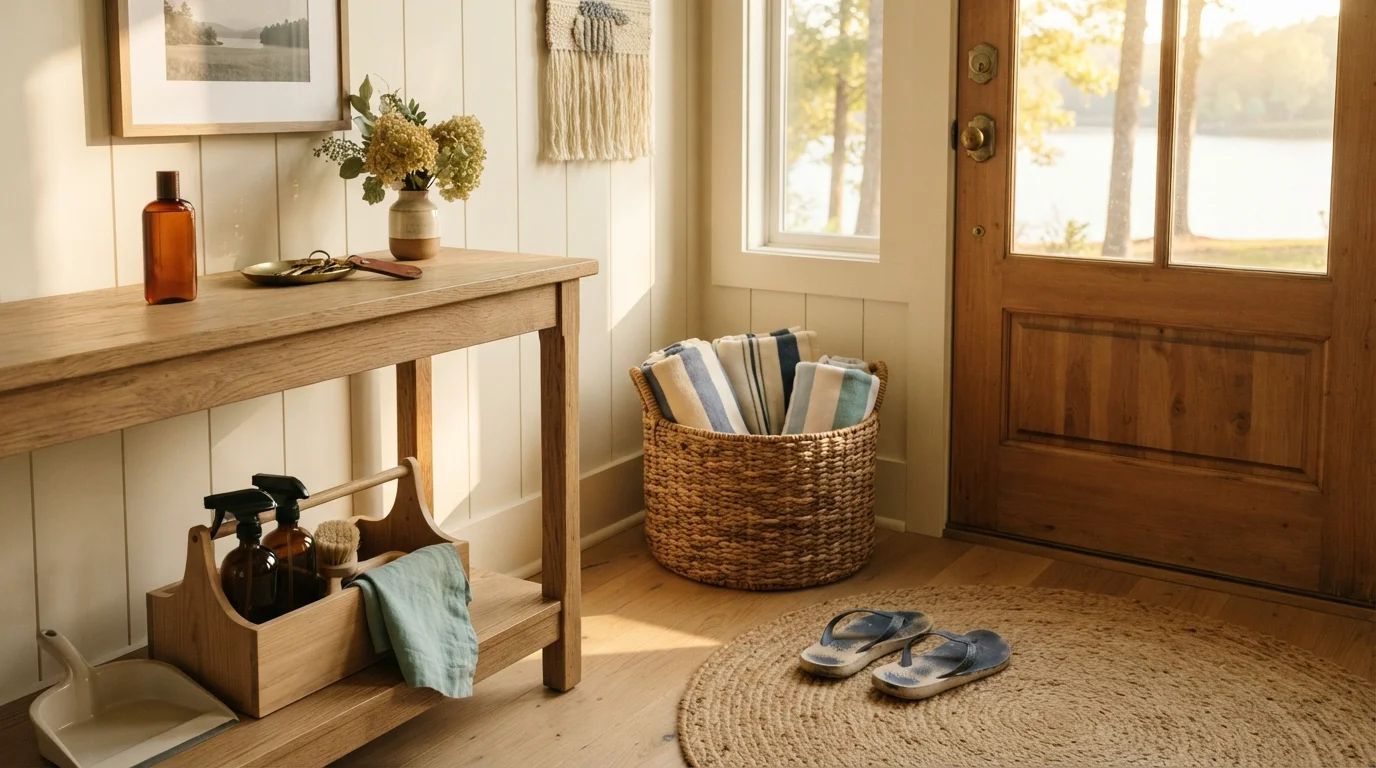
Take shoes off at the door. Shoes track pollen-loaded outdoor debris straight into the home. A small basket or bench at the entry is one of the highest-impact pollen-control changes a household can make.
Allergy-Household Add-Ons
If anyone in the household has spring allergies, a few additional protocols matter.
- Change clothes at the door after time outside; bag and launder them rather than hanging them in closets
- Shower at night rather than morning to remove pollen from hair and skin before bed
- Wash bedding weekly during pollen peak — pollen transfers from skin and hair to sheets fast
- Run a HEPA air purifier in the primary bedroom 24 hours during peak
- Wipe down pets when they come inside — their fur collects pollen and brings it to every surface they touch
For deeper guidance on allergen management as a year-round strategy, our allergen risk scanner walks through the major contributors.
When to Schedule a Professional Deep Clean
The right window for a professional pollen-season deep clean is late April to early May — after pine pollen has wound down but before summer humidity creates new problems.
A post-pollen deep clean targets the surfaces that accumulated pollen residue throughout peak: window sills, blinds, ceiling fans, baseboards, vents, screens, and any soft surface (drapes, upholstery, area rugs) that trapped pollen during the season.
Done well, this single annual reset removes the cumulative pollen load and restores the home’s air quality through summer. For a complete room-by-room walkthrough of what to tackle, see our ultimate spring cleaning checklist for North Georgia homes.
For a fuller breakdown of when each type of professional cleaning makes sense, see recurring cleaning vs. deep cleaning.
What Lanier Pristine Does Differently During Pollen Season
We use HEPA-filtered vacuums year-round, but they earn their keep most during March and April.
We pre-rinse outdoor cleaning tools before bringing them inside, so we are not introducing pollen during the visit.
We schedule pollen-related deep cleans in late April for the homes that want them.
And we always recommend the simple stuff first — door mats, filter changes, window discipline — before expensive solutions.
Half the benefit of professional cleaning is doing the small things consistently rather than the big things occasionally.
The Bottom Line
Pollen season is not a four-week home invasion.
It is a four-week shift in cleaning strategy.
Damp microfiber instead of dry dusting.
HEPA vacuum instead of standard.
Filter upgrades during peak.
Doors and windows closed.
Shoes off at the entry.
These changes cost almost nothing and dramatically reduce how much pollen ends up inside.
If you would like a professional post-pollen reset for your home, request a free quote — late April is our busiest week of the year, so booking a few weeks ahead helps.
We will get your home back to its pre-pollen baseline — and for the seasons that follow, our year-round seasonal cleaning guide maps what each one asks of a North Georgia home.