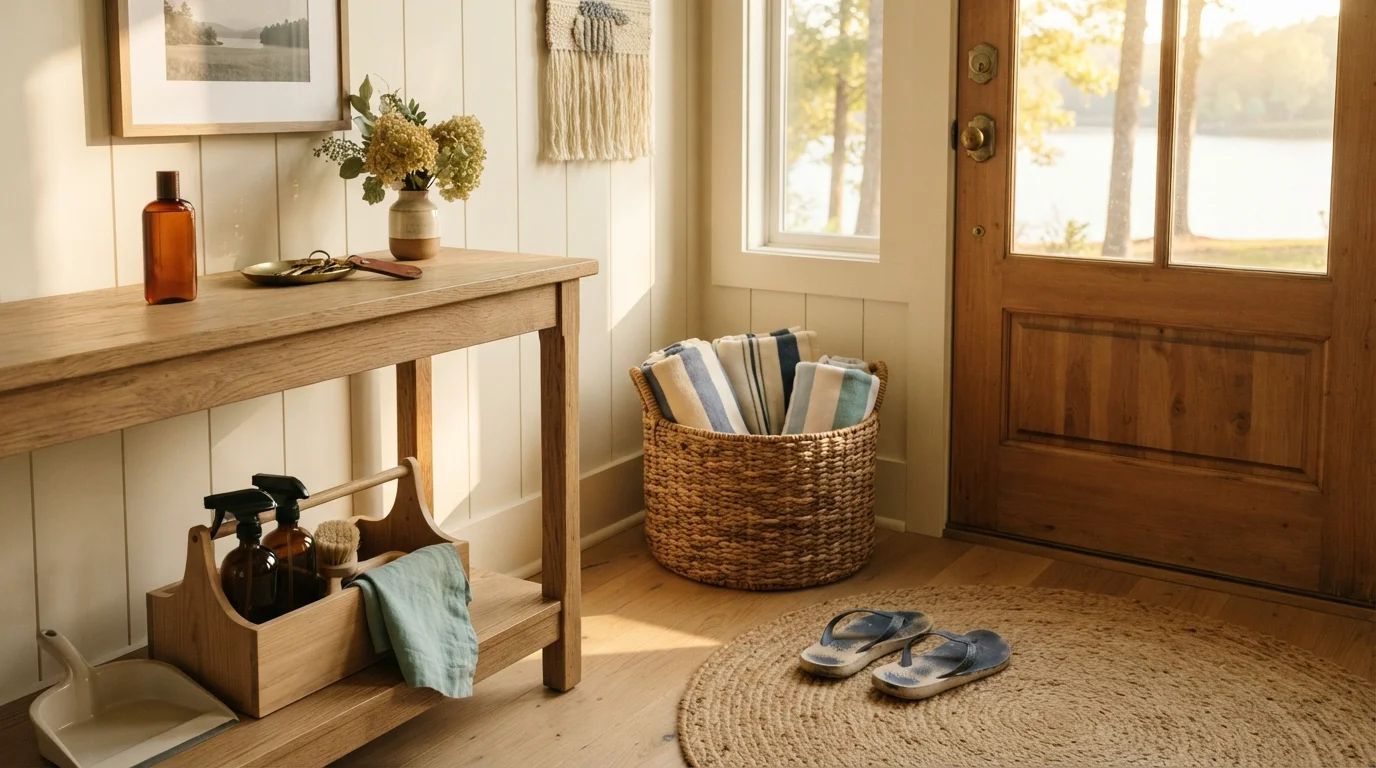

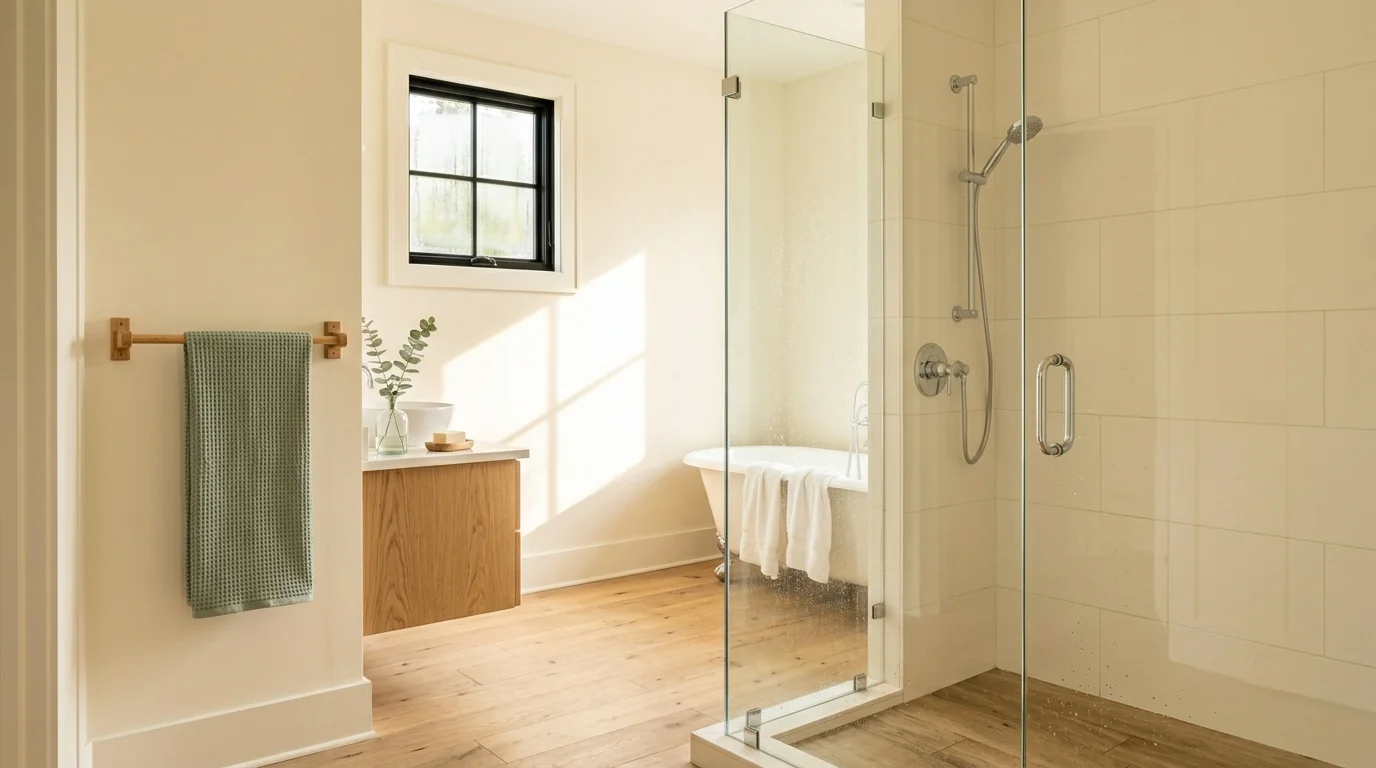
There is a specific week every summer — usually deep in August — when you open the front door, step inside, and the air just feels heavy.
Not hot, exactly. Thick.
And you can smell it before you can name it: that faint, damp, slightly sour note drifting from the hall closet, or the guest bath, or somewhere you can’t quite place.
That is mildew. Around Lake Lanier, it is not a sign you have done something wrong. It is a sign it is August.
Short answer: North Georgia summers are humid enough to grow mildew on their own — lake-area humidity averages near 76% in August, and mildew starts colonizing surfaces above roughly 60% relative humidity. You beat it with moisture control, not elbow grease: ventilate, run a dehumidifier to hold indoor humidity below 50%, change your AC filter on schedule, and clean the spots where it hides before the smell arrives. Here is the playbook.
After 20+ years cleaning North Georgia homes through the summer, I can tell you the houses that stay fresh in August are not the ones that scrub the hardest. They are the ones that keep the air dry.
Why a North Georgia summer is a mildew engine
Mildew is not dirt. It is a living thing — a surface fungus that needs three ingredients to grow: a little organic food (dust, skin cells, soap film), a surface to sit on, and moisture. In a Lake Lanier summer, your home hands it all three.
Two of those three you can’t change. There is always a little dust, and there are always surfaces. The third — moisture — is the one variable you actually control, and it is the one our climate works against you on. North Georgia sits in a humid-subtropical band where summer air routinely carries 65–80% relative humidity, peaking around 76% in August (NOAA climate normals for the Gainesville area). Add a 38,000-acre lake breathing moisture into the air all season, and the dew point stays high enough that surfaces never fully dry between humid days.
The threshold that matters: mildew gets comfortable above about 60% relative humidity. Your air conditioner is your first line of defense — it pulls moisture out of the air as it cools — but a tired system, an undersized one, or one running behind a clogged filter loses that fight, and the house slowly climbs back above 60%. That is the week you start smelling it.
Where mildew actually hides
By the time you can see mildew — black speckling in shower grout, a pink film around a drain — it has usually been growing somewhere you can’t see for weeks. The usual suspects in a lake-area home:
- Shower and tub grout and caulk — porous, constantly wet, and poorly ventilated. Ground zero.
- Closets and the backs of furniture on exterior walls — still air against a cool wall surface where humidity condenses.
- Under sinks and around the dishwasher — a slow leak plus darkness is all it needs.
- The HVAC system — the evaporator coil and drain pan stay wet all summer. A dirty filter turns the whole system into a humidifier that distributes spores room to room.
- Window frames and sills — condensation collects where cool indoor glass meets humid air.
- The front-loading washing machine door gasket — the single most-forgotten mildew home in the house.
- Basements, crawlspaces, and lake-house lower levels — naturally cooler and damper, and on the water they rarely get the airflow they need.

The dry-it-out playbook (this matters more than any product)
If you only do one thing this summer, make it this: keep the indoor air below 50% relative humidity. Below 50%, mildew can’t establish; above 60%, it thrives. A $15 hygrometer on a shelf tells you where you stand.
How to get there and stay there:
- Run the bathroom exhaust fan during and 20–30 minutes after every shower. That single habit removes the most concentrated burst of moisture in the house before it can settle into grout and drywall.
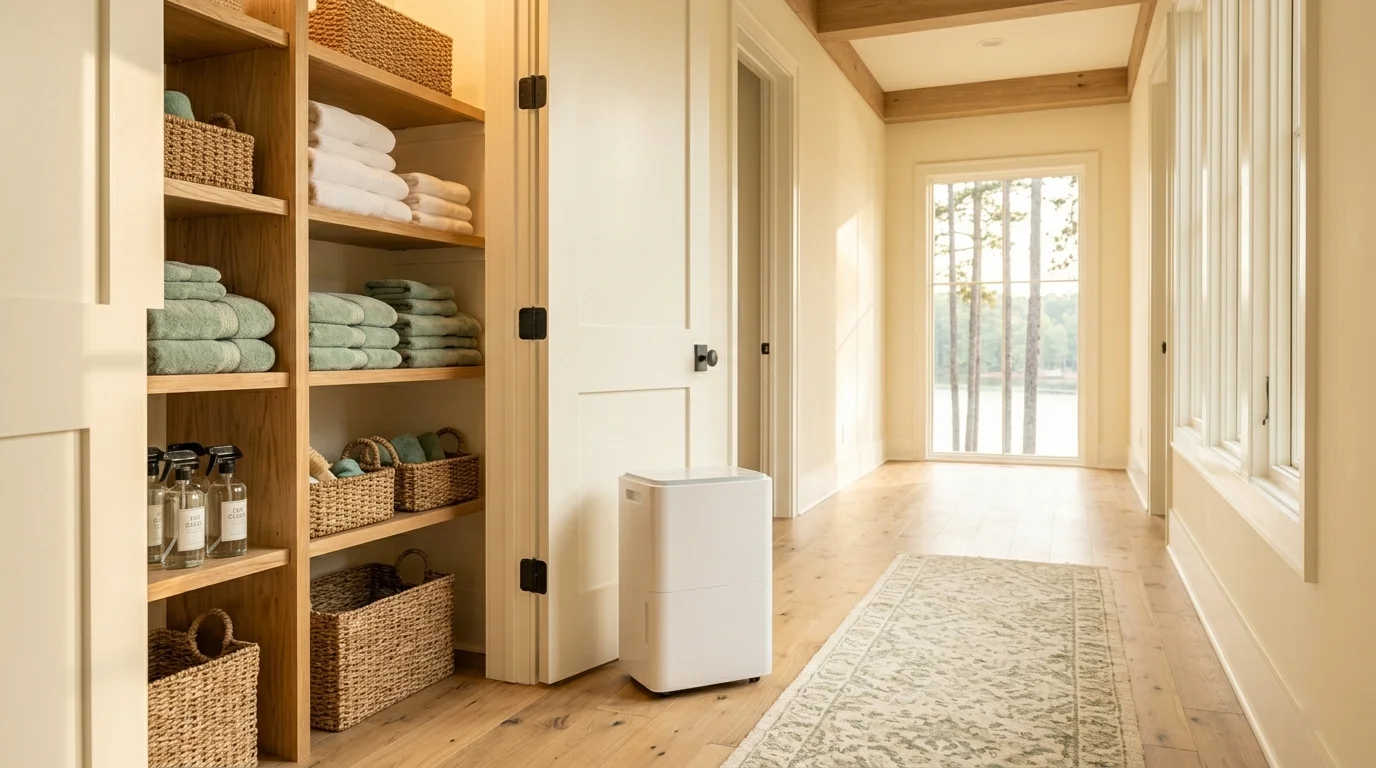
- Run a dehumidifier in the dampest zone — usually a basement, a lower level, or a back closet — and empty it (or plumb it to a drain). Set it to hold 45–50%.
- Change your AC filter every one to two months in cooling season (U.S. Department of Energy guidance), monthly with pets. A clogged filter cuts efficiency 5–15% and lets damp, dusty air recirculate — exactly what mildew wants.
- Let the AC run. Setting the thermostat way up while you’re out feels thrifty, but in July and August it lets humidity climb back over the line; the house then spends the evening trying to catch up. A steadier setpoint keeps the air dry.
- Close windows on humid days. A lake breeze feels nice, but on an 80%-humidity afternoon you’re inviting the moisture in.
How to actually clean mildew (and the bleach myth)
Here is where most people waste their effort. They see black grout, hit it with bleach, watch it turn white, and call it done. Two weeks later it’s back, and they assume they need more bleach.
The problem: on a porous surface like grout or silicone caulk, bleach lifts the color off the surface but doesn’t reach the roots growing down into the pores. You bleached the stain; you didn’t kill the colony. It regrows from underneath.
What actually works:
- Use a product matched to the surface — a dedicated mildew remover or a hydrogen-peroxide-based cleaner that penetrates, not just a surface bleach. We use eco-friendly products that are safe around kids and pets and still do the job.
- Give it dwell time. Let it sit and work; don’t spray and immediately wipe.
- Scrub the texture, not just the face — a grout brush reaches into the pore.
- Then dry it and fix the source. If the caulk is failing or stays wet, no cleaner will hold — re-caulk and improve ventilation. This is the step everyone skips, and it’s the only one that makes the result last.
The lake factor: sediment, wet towels, and damp lower levels
A waterfront or near-water home adds its own summer load. Lake sediment and fine grit ride in on feet and dock shoes and settle into entryways and bathrooms. Wet swimsuits and towels pile up and stay damp. Lower levels and walk-outs sit closest to the water and the cool ground, so they’re the first to feel muggy.
None of it is hard to manage — but it does mean a lake-area home benefits from a slightly more frequent rhythm in summer than a dry-county suburban home, especially in the bathrooms and entry zones.
What Lanier Pristine does differently
We treat a North Georgia summer as a moisture problem, not a dirt problem. On a summer visit, the same small team that knows your home checks the places mildew hides before it shows — the gasket, the under-sink, the closet corners — and uses color-coded microfiber to keep bathroom and kitchen tools separate so nothing spreads. Our vacuums are HEPA-filtered, so we’re capturing spores and dust, not stirring them back into already-humid air. And because it’s the same team each visit, they remember your home’s damp spots and stay ahead of them.
Beat the August peak — book ahead of it
The move is to reset the house heading into summer, then keep it on a steady rhythm — not to chase mildew once it’s established in August. A deep cleaning in late spring or early summer clears the slate; recurring service keeps the bathrooms, entry, and damp zones in check through the worst of it. (Coming out of pollen season? A reset does double duty.)
If your home is already telling you it’s August — that heavy air, that closet smell — reach out for a quote. We serve the full Lake Lanier corridor with same-week scheduling, and we’d rather help you get ahead of next summer than fight this one. For the bigger picture, see our year-round seasonal cleaning guide.