

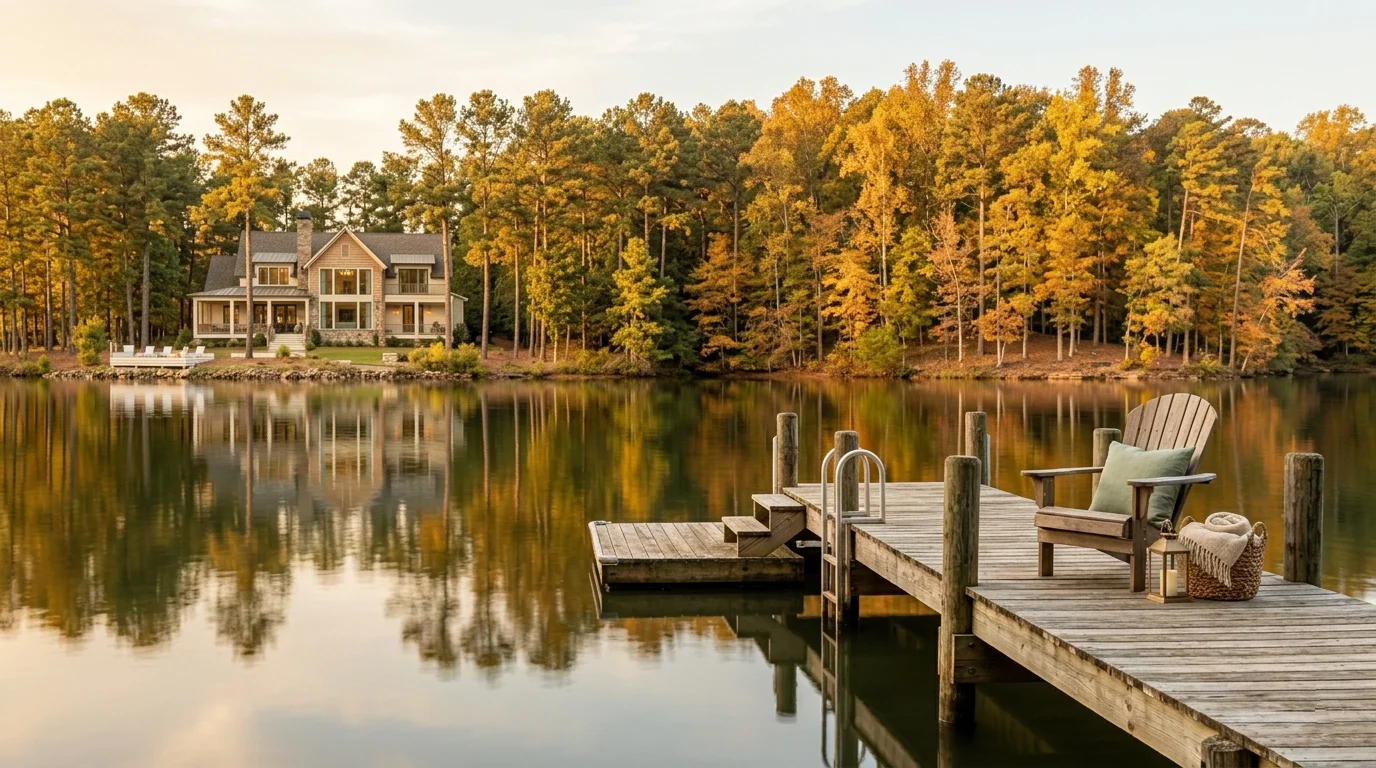
There’s a weekend every October when Lake Lanier goes quiet.
The last of the boats come out, the dock stops creaking under wet feet, and the water starts to pull back from the shoreline. The wooded lots go gold, then bare. The house that ran hot all summer is suddenly still.
That quiet is the signal. It’s time to close the lake house for the season.
Short answer: Fall on Lake Lanier is a transition, not a deep freeze. As the U.S. Army Corps of Engineers begins drawing the lake down from its 1,071-ft summer full pool toward the 1,070-ft winter target (and lower in flood-control years), ragweed peaks in mid-September, and the wooded lots shed their leaf load, your lake house needs three things: a thorough transition clean, a pre-winter maintenance pass (gutters, dryer vent, HVAC), and a humidity plan so a quieter, closed-up house doesn’t go musty. Here’s the owner’s checklist for easing a lake house into the off-season.
After 20+ years cleaning North Georgia homes — Lake Lanier properties chief among them since 2020 — I can tell you the lake houses that open clean in the spring are the ones that were closed well in the fall. The work you skip in October is the smell you fight in April.
Before you close, reset. Everything below assumes the house has already had its end-of-summer reset — closing a lake house that still carries a summer’s worth of sunscreen film, sand, and damp linens just seals all of it in until spring.
Fall on the lake is a second allergy season
Most people think of pollen as a spring problem. On a wooded Lake Lanier lot, fall brings a second wave — a different culprit.
Ragweed releases pollen from August through November, peaking in mid-September, according to the Atlanta Allergy & Asthma Center. It’s among the most allergenic pollens there is, and — the part that matters for a lake house — it’s very light. Ragweed pollen travels far on the wind, drifting in off open fields and roadsides and settling onto decks, screens, and anything you leave out.
If you remember the pine-versus-hardwood lesson from our spring pollen guide, this is its autumn echo. In spring, the visible yellow pine dust is the mess but barely the allergy trigger — the invisible hardwood pollen does the real damage. In fall, ragweed is both: an aggressive allergen and one that rides in on the same paths as the leaf litter. So the cleaning discipline is the year-round one — capture and contain, don’t stir and spread. Damp microfiber instead of dry dusting. A HEPA-filtered vacuum instead of one that blows fine particles back into the air. Screens and screened porches wiped down before you close them up, because they’re the reservoirs that hold ragweed and leaf grit all winter.
If anyone in the household reacts in the fall, our allergen risk scanner walks through the major indoor contributors and how to stay ahead of them.
The leaf load on a wooded lake lot
A lake house on a wooded lot earns its view and pays for it in leaves.
In the North Georgia mountains, color change begins around the last week of September and rolls downhill — roughly 1,000 feet of elevation per week, according to Georgia State Parks’ Leaf Watch. Down at Lake Lanier’s elevation, peak foliage lands in the mid-to-late October window — what most locals think of as the last weekend of October — as a multi-week wave rolling into November, not a single fixed date.
For a homeowner, peak color means peak drop. On a lake lot, leaves aren’t just a yard chore — they’re a house problem:
- Gutters fill fast. A heavily treed lot can clog a gutter run in a single windy week, and clogged gutters in winter mean overflow, ice damming, and water finding its way against the foundation.
- Leaves get tracked inside. Every trip from the dock to the door carries wet leaf debris and the fine grit underneath it into entryways and lakeside rooms.
- Wet leaf mats hold moisture against decking and roofing. Left on a deck or a low roof valley through a damp fall, they stain, rot, and feed mildew — now with no AC running to dry the air.
The move is to clear the leaf reservoirs before you lock up: gutters cleared after the drop, decks and porches swept and rinsed, screened areas vacuumed and wiped. Otherwise you’re sealing a season of organic debris into a house about to sit still for months.
Reading the lake: drawdown and the waterline
Part of closing a lake house well is understanding what the water is doing in the fall, because it changes the look — and the chores — at the shoreline.
Lake Lanier sits at full pool of 1,071 ft above sea level in summer and eases to a 1,070-ft target in winter. That one-foot difference is a deliberate U.S. Army Corps of Engineers flood-control buffer, capacity held back to absorb spring rainfall. The Corps begins its winter drawdown in the fall, and in a wetter year it draws the lake down further — typically toward the 1,060–1,065-ft range — to open up flood storage.
What that means at your dock: through the fall, the waterline retreats. Sections of shoreline, dock cribbing, and the lower reaches of your dock that stayed underwater all summer come into the air. That newly exposed band is where summer’s lake biofilm — the slick green-brown film that coats anything at the waterline — dries out and shows itself. Fall, as the water drops, is the natural time to address the dock area and the exposed waterline equipment before everything freezes, and to bring in or secure anything that shouldn’t ride out a winter of fluctuating levels.
(Note: I’m describing the cleaning and transition side of the dock. Actual mechanical winterizing — water systems, pipes, and the closed-home routine — is its own job, and one we’ll cover in the winter work.)

The pre-winter maintenance pass
A lake house about to sit quiet for the off-season deserves a maintenance pass while you’re still there to do it. Three items matter most.
Gutters — clear them after the leaves drop. The standard home-maintenance rhythm is twice a year, spring and fall, with the fall pass done after leaf drop. On a heavily wooded lake lot, you may need more — the more tree cover overhanging the roof, the faster the runs fill, so one fall pass often isn’t enough. Clogged gutters are the most common way winter water damage starts.
Dryer vent — clean it once a year. The U.S. Fire Administration recommends clearing lint from the dryer vent pipe annually (more often if loads take longer than normal to dry). It’s not just efficiency — lint buildup is a leading cause of dryer fires. Closing the house for the season is a natural once-a-year checkpoint.
HVAC filter — fresh before the system changes seasons. The U.S. Department of Energy advises cleaning or replacing the filter every month or two through the cooling season, with furnace and heat-pump filters checked monthly or as needed; a clean filter can cut a system’s energy use by 5 to 15 percent. Heading into a quieter season — especially if you’ll leave the system holding a temperature to manage humidity — start it on a fresh filter so it isn’t recirculating a summer’s worth of dust and ragweed.
A fresh frost is nearly certain in Gainesville by November 22 (NOAA 1991–2020 climate normals), with risk starting around October 26. That’s the practical deadline: get the maintenance pass done while the weather still cooperates.
The musty-house problem in a closed lake home
Here’s the trap that catches lake-house owners every winter — the same enemy we fight all summer, just with the AC turned off.
A house that sits quiet and closed doesn’t stop holding moisture. Nobody’s opening doors, cycling the air, or running the bathroom fan. On a wooded lot beside a large reservoir, the dampest zones — lower levels, lakeside closets, basements against cool ground — climb back toward the conditions where mildew takes hold; the EPA recommends keeping indoor humidity below about 60% for exactly this reason. Give a sealed, still house a few damp weeks and the musty smell sets into grout, closets, and the washer gasket — the spots you’ll notice the moment you walk in next spring.
The fix is the same upstream discipline that works in summer, adapted for a house no one will cycle air through for months:
- Don’t fully kill the climate control. Leave the system holding a steady setting so the air keeps moving and never sits saturated. With the house empty for weeks at a stretch, a thermostat you can watch and adjust remotely earns its keep — you catch a heat outage or a humidity swing from your phone instead of discovering it in April.
- Give the dampest zones a no-power backup. Run a dehumidifier where you can, but in closets and corners far from an outlet, set out moisture absorbers that keep working with nothing plugged in — the spots closest to the water and cool ground are where they pay off.
- Close the house dry, and leave it open to itself. Dry every wet zone before the final lock-up, then prop interior and closet doors ajar so no sealed pocket of damp air sits trapped while the house is vacant.
- A dry house, closed dry, stays fresh. The smell develops in the gap between visits — so the work that prevents it has to happen before you turn the key.

If you rent the house: hand off to the off-season deep clean
Everything above is the homeowner’s fall transition. If your lake house is also a short-term rental, fall is when a different, heavier job comes due: the annual off-season deep clean.
That’s a distinct scope with its own playbook. It reaches the things a busy summer of turnovers can never touch, and it carries its own timing, cost ranges, and booking math. Rather than re-cover it here, I’ll point you to the dedicated guide: the off-season deep clean for Lake Lanier rentals walks through exactly what it includes, when to book it, and how it pays back in your review scores and your appliances. If you’re not sure which level of service your property needs, our breakdown of recurring cleaning versus deep cleaning helps you tell them apart.
What Lanier Pristine Does Differently
We treat closing a lake house as a transition, not just a final cleaning. The same small team that knows your home runs the fall pass with the off-season in mind: HEPA-filtered vacuums tuned to capture the ragweed and leaf grit that define a fall close, color-coded microfiber so bathroom and kitchen tools never cross, and a deliberate sweep of the fall-specific reservoirs — the screened porches, the entry mats by the dock door, and the leaf debris that gets walked indoors. Because it’s the same crew each visit, they remember where your house holds moisture and where the dock-area waterline needs attention as the drawdown exposes it. And we’ll tell you plainly when a house needs a dehumidifier or a smart thermostat for the off-season rather than one more scrub. For an owner-occupied home, that’s our recurring service or a one-time deep clean, done with eco-friendly products safe to leave behind in a closed house. If the house earns its keep as a rental, that work sits inside vacation rental cleaning on Lake Lanier instead.
Book the fall transition before the lake goes quiet
The lake houses that open fresh in spring get closed well in October and November — after the leaves drop, before the first hard frost. The drawdown is starting, the ragweed is settling, and the calendar narrows fast once the foliage peaks.
If you’d like a team that treats closing your Lake Lanier house as the careful hand-off it is — the transition clean, the pre-winter pass, and a real humidity plan for the quiet months — reach out for a quote. We serve the full Lake Lanier corridor and book the fall window early. For the bigger picture, see our year-round seasonal cleaning guide.