

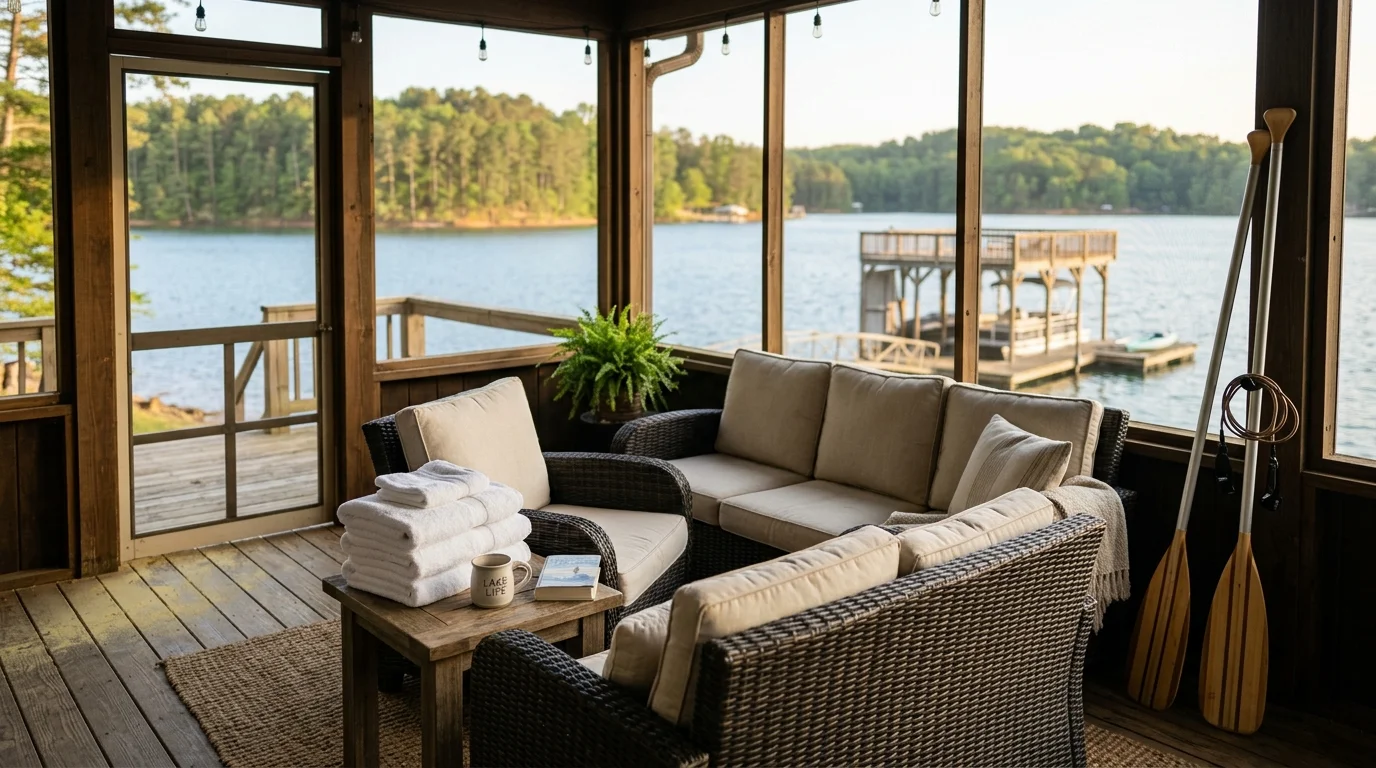
Own a home on Lake Lanier? You already know the tradeoffs.
The sunsets over the water and the quick boat access are incredible.
But keeping the property clean is a completely different battle than maintaining a home in a standard subdivision.
We see this daily in our work across Gainesville and Flowery Branch.
Humidity works harder here.
Insects are more aggressive.
The soil itself seems determined to ruin your floors.
Our team has spent years refining the specific protocols needed to counter these waterfront challenges.
If you’re hosting your lake house as a vacation rental, see our complete Vacation Rental Cleaning Guide for Lake Lanier Hosts for the full picture on turnover standards, seasonal strategy, and host operations. The challenges below apply to all lake house owners — but they hit short-term rentals especially hard.
Here is exactly what we face and the specific methods we use to keep these properties pristine.
1. Humidity and Rapid Mildew Growth
This is the silent killer of lake house interiors.
Proximity to the water keeps local ambient humidity significantly higher than in inland areas.
Combine that with a standard Georgia summer, and you have a recipe for rapid microbial growth.
We routinely see mildew form on bathroom grout, inside dark closets, and along window sashes in just 48 hours.
The real danger zone is indoor relative humidity above 60%.
Once moisture hits that level, mold spores can colonize porous surfaces like drywall and wood.
How to Control Moisture Levels
- Target 50% Humidity: Install dedicated dehumidifiers in basements and terrace levels. We recommend units capable of removing at least 50 pints of water per day for spaces over 1,500 square feet.
- Monitor with Hygrometers: Place small digital hygrometers (like those from Govee or AcuRite) in closets and basements.
- Create Airflow in Dead Zones: Keep closet doors louvred or open. Stagnant air pockets behind solid doors are prime breeding grounds for mildew.
- The “Vacation Mode” Rule: If you leave the house empty, never set the AC higher than 78 degrees. Anything higher allows humidity to creep past that dangerous 60% threshold.
Pro Tip: Wipe down your window sills and sashes with a borate-based cleaner once a season. This leaves a residue that inhibits mold growth even when condensation forms on the glass.
2. The Red Clay and Sediment Battle
The soil in the Georgia Piedmont region is rich in iron oxide.
That is what gives our famous red clay its color and its staining power.
It acts more like a dye than dirt.
Sand and grit from the shoreline also wreak havoc on hardwood finishes.
We find that a standard vacuum often just pushes this heavy grit deeper into carpet fibers.
Protocols for Floor Protection
| Surface Type | The Challenge | The Solution |
|---|---|---|
| Hardwood | Grit acts like sandpaper, scratching the finish. | Use a microfiber dust mop daily; avoid broom bristles that drag grit. |
| Carpet | Red clay particles embed and stain fibers. | Vacuum with high-suction (HEPA) units; use professional extraction twice a year. |
| Tile/Grout | Porous grout absorbs the red iron oxide. | Seal grout lines annually; use a neutral pH cleaner to lift clay without damaging the seal. |
Strategic Defense Zones
- The “Three-Mat” System: Place a scraper mat outside, a wiper mat just inside the door, and a runner rug in the immediate hallway. This traps 85% of debris before it hits your main living area.
- Boot Rinse Stations: Install a simple hose or boot scraper near the path up from the dock.
- No-Shoes Policy: It sounds strict, but keeping a basket for “lake shoes” at the door is the single most effective way to protect your flooring investment.
3. Insect Intrusion: Joros, Midges, and Spiders
Waterfront lighting acts as a beacon for insects.
In recent years, North Georgia has also seen an explosion of the Joro spider.
These large weavers create massive, golden webs that can span entire patio openings overnight.
You also have to contend with “lake flies” (midges) that swarm lights and die in piles on window sills.
Standard pest control often stops at the foundation, but lake houses require a more vertical approach.
Defensive Cleaning Tactics
- Switch to Warm Lighting: Swap exterior white bulbs (3000K+) for amber or yellow LED bug lights (2000K). Insects are far less attracted to this spectrum.
- Weekly Eave Sweeping: An extension pole makes quick work of eaves, dock roofs, and porch corners. Removing the “anchor webs” weekly discourages spiders from rebuilding in the same spot — an outdoor job for the homeowner or a specialist, not part of an interior clean.
- Seal the Gaps: Caulk around cable lines, dryer vents, and exterior faucets. Even a gap of 1/8th of an inch is a highway for ants and roaches looking for water.
- The Peppermint Deterrent: Spiders hate strong scents. Spraying a diluted peppermint oil mixture around door frames can act as a natural, safe deterrent between professional treatments.
4. The Pollen “Yellow Haze”
Mid-March through May in North Georgia is intense.
Pine pollen counts in the Gainesville and Lake Lanier area frequently exceed 8,000 particles per cubic meter during peak season.
This yellow dust is coarse and abrasive.
It coats decks, screens, and outdoor furniture in a thick film that can ruin cushions if left to sit and get wet.
Managing the Pollen Drop
- The “Top-Down” Wash: Always start cleaning from the highest point (eaves/gutters) and work down to the deck floor. Otherwise, you will just wash pollen onto clean surfaces.
- Change Filters Monthly: During peak season, standard 90-day HVAC filters clog in weeks. Switch to MERV 11 filters to capture finer particles without choking your system.
- Protect Fabrics: Cover outdoor furniture or store cushions in deck boxes. Cleaning pollen paste out of outdoor fabric is difficult and often leaves permanent water rings.
- Screen Maintenance: Gently scrub screened porches with a soft bristle brush and mild soap. Pollen gets trapped in the mesh and restricts airflow, making the porch hotter.
5. What the Dock and Outdoor Areas Bring Indoors
The dock and the deck are where a lake house actually lives in summer — and everything that collects out there eventually comes inside, on feet, on towels, and on gear.
This is the part worth planning for, because it is the part that lands on your floors.
Tannin and algae residue. Wet leaves sitting on decking leach dark tannins, and damp boards grow a thin algal film. Both transfer to bare feet and shoe soles, and both stain indoor textiles — entry rugs and runners take the worst of it.
Lake sediment and sand. Whatever is on the dock is on the path back to the door. Sand is abrasive once it is inside, working on floor finishes in the high-traffic lane between the lake door and the kitchen.
Bird droppings. Highly acidic, and a genuine problem on outdoor surfaces — but the indoor concern is simpler: it comes in on the bottom of shoes if it is not noticed.
Damp gear. Towels, swimsuits, and life jackets that come off the dock and go straight into a heap are the most reliable way to give a lake house a musty smell.
What that means inside
- Entry discipline at the lake door. A coarse mat outside and a second one inside, plus a clear landing spot for wet gear, stops most of the above at the threshold instead of distributing it through the house.
- Treat the first ten feet as its own zone. That lane is where sediment, tannin, and sand concentrate. Vacuuming and mopping it more often than the rest of the floor is the single highest-return habit on a lake property.
- Dry the gear, do not stack it. Hang towels and swimsuits or run them through a dryer rather than letting them sit.
What stays on the homeowner’s list
Dock and deck upkeep itself is outdoor property maintenance, and it is a different job from cleaning a house. If you handle it yourself, two notes worth having: skip chlorine bleach on dock surfaces, since it damages wood fibers and is the wrong thing to put next to the water, and clear wet leaves off decking promptly rather than letting the tannins set.
To be plain about our own scope: Lanier Pristine is interior-focused. A light surface tidy of a porch or screened room is possible while the team is on site, but no deep or specialized exterior cleaning is offered. Docks, decks, and exterior surfaces are not something we take on — what we handle is everything they send indoors.
6. Hard Water Mineral Deposits
Water from wells around the lake often has high mineral content.
Even municipal water in the area can leave calcium and magnesium deposits.
These minerals bond to glass shower doors and chrome fixtures.
If you let these spots dry and cure, they eventually etch the glass permanently.
We see many homeowners trying to scrub these off with abrasive pads, which only scratches the glass further.
The Clarity Protocol
- Squeegee Religiously: This is the only way to prevent buildup. Keep a squeegee in every shower and use it after every single use.
- Vinegar Soaks: For existing buildup on faucets, soak a paper towel in white vinegar and wrap it around the fixture. Let it sit for 30 minutes to dissolve the minerals before wiping.
- Hydrophobic Coatings: Apply a treatment like Rain-X or a dedicated glass sealant to shower doors every three months. This causes water to bead up and roll off, taking the minerals with it.
- Avoid Bar Soap: The talc and fatty acids in bar soap combine with hard water minerals to create stubborn soap scum. Switching to liquid body wash significantly reduces shower scrubbing time.
Keeping Your Lake House Ready
Owning a waterfront home should be about relaxation, not constant scrubbing.
The key is shifting from reactive cleaning to proactive maintenance with a recurring cleaning schedule. Once a hard summer is behind you, the catch-up job has its own playbook — see the end-of-summer reset.
Understanding that the lake environment is aggressive helps you stay one step ahead of the mildew and the mud.
Our team at Lanier Pristine handles these specific lake house cleaning challenges every day.
We know exactly when the spiders are most active and which weeks the pollen counts will spike.
You deserve to arrive at your lake house and see the water, not the work.
Let us handle the details so you can enjoy the view.