

“Eco-friendly cleaning” has become marketing shorthand that often means very little.
A bottle with a green label and a leaf icon is not the same as a non-toxic, biodegradable formula.
After 20+ years of buying cleaning products commercially in North Georgia, I have watched the industry shift dramatically toward genuinely cleaner formulations.
But I have also watched a parallel shift in greenwashing — packaging and language designed to look eco-friendly without the substance behind it.
This guide explains what actually matters in eco-friendly cleaning, what we use at Lanier Pristine, and when DIY products you already own are good enough.
What “Eco-Friendly” Should Actually Mean
A genuinely eco-friendly cleaning product meets several criteria.
Most products marketed as “green” meet only one or two of these.
A real one meets all of them.
- Biodegradable — the formula breaks down in water systems within a reasonable time
- Plant-based active ingredients — surfactants and solvents derived from plants rather than petroleum
- Free of common irritants — no synthetic dyes, no synthetic fragrances, no chlorine bleach, no ammonia, no glycol ethers
- Reasonable packaging — concentrate format that ships in less plastic, refillable bottles, or recyclable containers
- Third-party certified — labels like EPA Safer Choice, Green Seal, or EcoLogo that verify the claims
- Honest ingredient disclosure — every ingredient listed by name, not hidden behind “fragrance” or “preservative system”
The third-party certification is the biggest tell.
EPA Safer Choice in particular requires actual review of every ingredient against a defined health and environmental standard.
A bottle without certification but with an aggressive eco-friendly marketing claim is suspect.
Why Lake Lanier Households Should Care
The cleaning products that wash down your drains end up in the watershed.
For most North Georgia homeowners that watershed includes Lake Lanier itself.
Many “regular” cleaning products contain compounds that are aquatic toxins at low concentrations — quaternary ammonium compounds, triclosan derivatives, and certain surfactants among them.
Switching to genuinely biodegradable products is one of the easier ways to reduce a household’s water-system impact.
If you spend time on the lake, this matters.
If you do not, it still matters because the same water comes back through your tap.
What We Use at Lanier Pristine
Our product list has narrowed considerably over the years as we have tested formulations.
The current short list:
- Plant-based all-purpose concentrates for surfaces (countertops, tables, glass)
- Hydrogen peroxide-based disinfectant for restrooms and high-touch surfaces — it breaks down into water and oxygen, leaves no residue, and matches the disinfecting power of bleach without the fumes
- Castile soap variants for floors and dishes
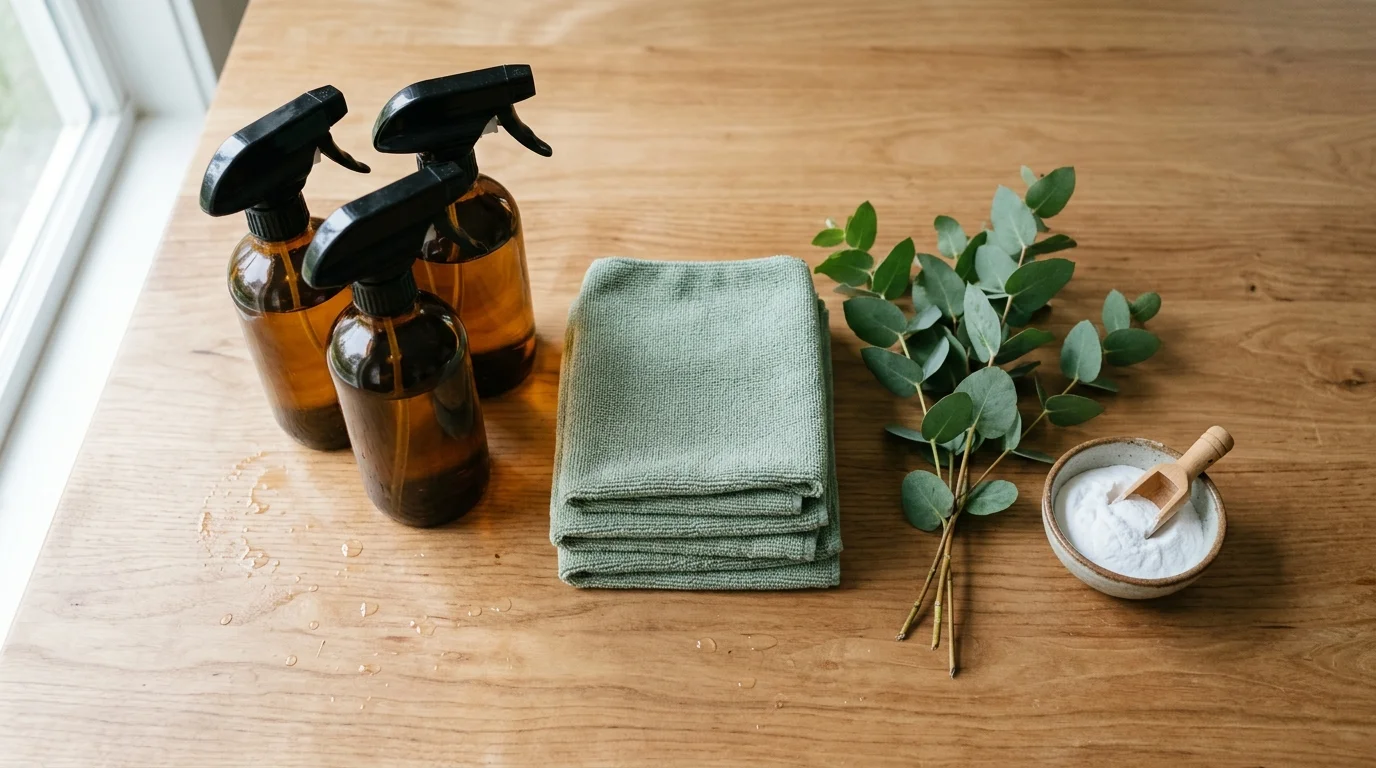
- White vinegar and baking soda for descaling, grout, and certain glass applications
- Microfiber cloths for nearly all wiping — these capture and hold particles mechanically, reducing the chemical load needed
- HEPA-filtered vacuums with sealed bag systems to prevent dust recirculation
We do not use:
- Bleach in concentrated form
- Pine-oil cleaners (toxic to cats)
- Aerosol furniture polishes
- Synthetic-fragrance air fresheners
- Ammonia-based glass cleaners
- Disposable wipes (waste-heavy and lower performance than microfiber)
This list works because cleaning is more about technique and equipment than about chemistry.
A high-quality microfiber cloth and water actually cleans most surfaces better than most chemical sprays.
The chemistry comes in for grease, hard water, and disinfection — and even there, plant-based options have caught up substantially.
When DIY Products Are Genuinely Enough
You do not need to buy specialty products for most household cleaning.
Three things in your pantry handle the majority of common cleaning tasks.
White vinegar
Cuts through hard water deposits, descales coffee makers, freshens drains, dissolves soap scum at low concentrations, and is a reasonable glass cleaner when diluted.
What it cannot do: cut grease (acid is the wrong chemistry), disinfect viruses (it is mildly antibacterial but not virucidal), or work on natural stone (it etches marble and travertine).
Baking soda
Mild abrasive that scrubs without scratching most surfaces, deodorizes by neutralizing acidic odors, and combined with hydrogen peroxide handles most stain removal.
What it cannot do: dissolve grease, sanitize surfaces, or work as a finishing polish.
Castile soap
Plant-based soap that works as a hand soap, dish soap, floor cleaner (heavily diluted), and all-purpose surface cleaner.
What it cannot do: descale, disinfect, or cut through baked-on grease.
For weekly maintenance cleaning of a tidy home, vinegar + baking soda + castile soap will get you 80 percent of the way there.
The remaining 20 percent — kitchen grease, bathroom mildew, hard water buildup, allergen control — is where commercial-grade products earn their keep.
When DIY Is Not Enough
There are specific situations where pantry products fall short.
- Bathroom mold and mildew — vinegar slows it but does not kill the spores; you need a peroxide-based or registered mold-killer product
- Heavy kitchen grease — needs a degreaser with the right pH for fat dissolution
- Hard water scale in showers — needs a scale-specific acid (vinegar works on light scale; heavier deposits need stronger formulations)
- Disinfection during illness — a household with someone sick needs a registered disinfectant, not a folk remedy
- Pet stains in carpet — needs an enzymatic cleaner that breaks down the proteins; baking soda alone leaves the source intact (for the broader pet household considerations, see our pet-friendly house cleaning guide)
- Post-construction dust — requires HEPA filtration and specific cleaning sequencing; see post-construction cleaning
For these jobs, even a green-cleaning household needs commercial products.
The good news is that genuinely eco-friendly versions of all of these now exist and perform comparably to their conventional alternatives.
Reading a Cleaning Product Label
If you want to evaluate any product yourself, this is the short checklist.
- Is every ingredient listed by name? “Fragrance” or “preservatives” without further detail is a red flag
- Is there third-party certification? EPA Safer Choice, Green Seal, EcoLogo, or USDA Biobased
- What does the SDS say? The Safety Data Sheet (downloadable from most brand websites) lists hazards in plain language
- Are claims specific or vague? “Plant-based” is more meaningful than “natural”
- Is it concentrated? Concentrates ship in less plastic and usually have higher-quality formulations
Spend 10 minutes evaluating one product you currently use this way and you will likely find a reason to switch.
Asking Your Cleaning Service
If you are hiring a service and care about the products they bring into your home, ask directly.
The questions to ask:
- Can you send me the list of products you use?
- Do you have any third-party certified products?
- Can you accommodate household-specific sensitivities or preferences?
- What do you use for disinfection?
- Do you use HEPA-filtered vacuums?
Reputable services answer these without hesitation.
If a service deflects or gives vague answers, that is the answer.
For a fuller framework on vetting a service, see how to choose a house cleaning service in Gainesville.
The Bottom Line
Eco-friendly cleaning is no longer a compromise.
The products that meet real environmental and health standards now perform as well as the conventional alternatives — sometimes better, because the manufacturers have to work harder to compete.
For most homes, switching to a small list of genuinely certified products plus better technique handles 95 percent of cleaning needs while reducing what goes down the drain.
If you would like to know what specific products and equipment we would use in your home, see our eco-friendly cleaning service — there’s no eco surcharge; it’s how we clean every home — or request a free quote and we will walk you through it before the first visit.