

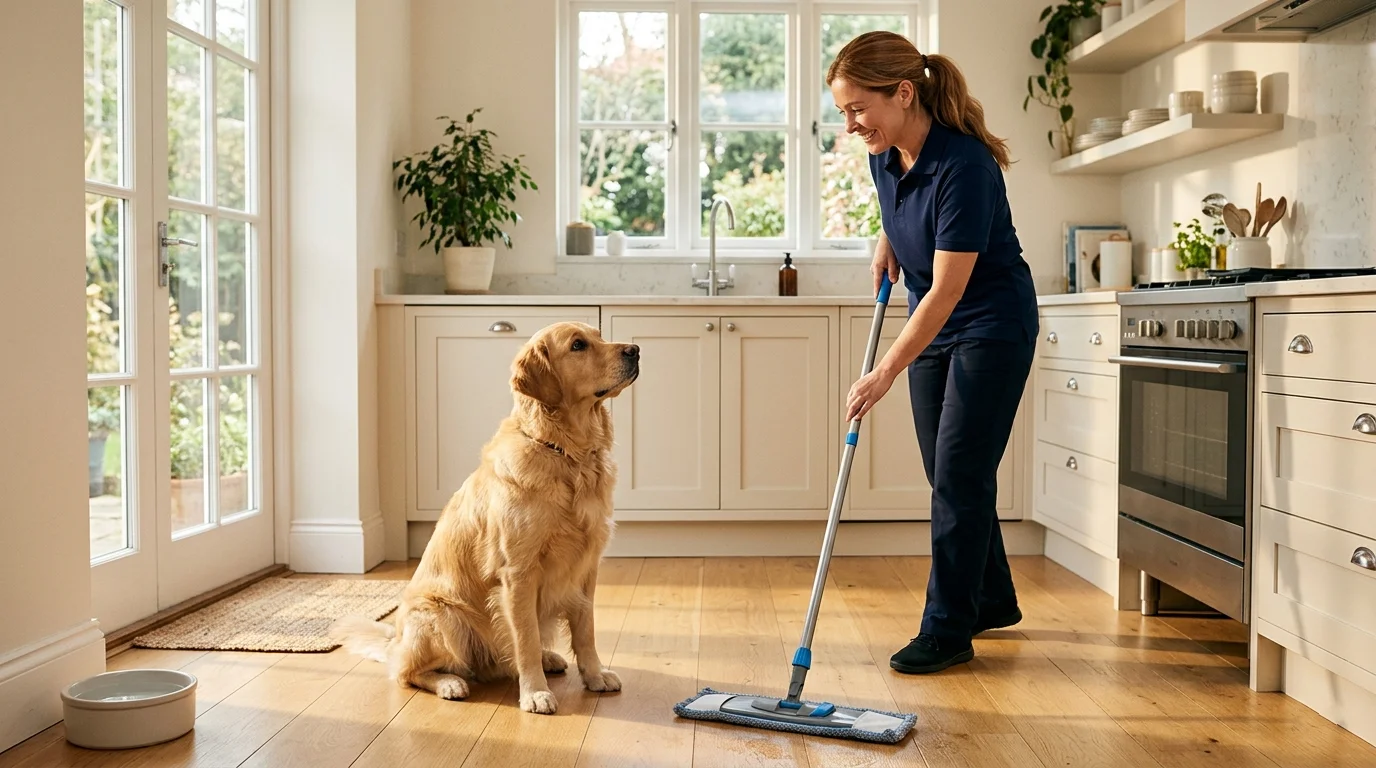
We have cleaned for cat households, dog households, multi-pet households, bird households, reptile households, and one memorable home with a pot-bellied pig.
Pets shape almost everything about how we approach a home — from the products we use to the order we work in to how we open doors.
If you have pets and you are considering professional cleaning, this guide answers the questions we hear most often.
It also covers the things pet owners do not always know to ask but should.
Pet-Safe Products: What “Safe” Actually Means
The phrase “pet-friendly cleaning products” gets used loosely.
Here is what it should mean.
A truly pet-safe product:
- Does not release fumes that linger in the air at concentrations that affect small lungs
- Does not leave chemical residue on floors that pets walk on and then lick off their paws
- Does not contain ingredients that are acutely toxic if a pet drinks the bucket water (this happens more than you would think)
- Has a known short list of ingredients you can actually look up
Common chemicals to avoid in homes with pets:
- Pine-Sol and similar pine-oil cleaners — toxic to cats in particular
- Bleach in concentrated form — fumes irritate pet airways; residue is dangerous
- Glycol ethers (in some all-purpose cleaners) — toxic to dogs and cats
- Phenols (in disinfectants) — highly toxic to cats
- Heavy ammonia — irritating; smells like cat urine, which can confuse training
What we use instead at Lanier Pristine: plant-based concentrates, hydrogen peroxide for disinfection where needed, and microfiber as a mechanical cleaning tool that reduces the chemical load.
You can ask any cleaning service for their product list.
A reputable service will share it without hesitation.
Shedding & Allergen Strategy
Pet hair and dander are the two biggest cleaning challenges in pet households.
Standard cleaning equipment is not designed for them.
A consumer vacuum picks up surface hair but misses the hair embedded into carpet fibers.
A standard dust cloth pushes dander around rather than capturing it.
What actually works:
- HEPA-filtered vacuums — these capture particles down to 0.3 microns, which includes most pet dander
- Microfiber cloths — these grip and hold particles rather than spreading them
- Rubber-edged squeegee tools on upholstery — these pull embedded hair out of fabric in a way vacuums cannot
- Slow, deliberate vacuuming — pet hair requires multiple passes, not one fast sweep
If allergies are a serious health concern in your household, ask your cleaner whether they use HEPA filtration and how they handle bedding, drapes, and upholstery.
For deeper guidance on allergen-driven cleaning, our allergen risk scanner walks through the major variables.
Working Around Dogs and Cats
Different pets need different approaches.
Dogs
Most dogs do well during a professional cleaning visit if they are introduced calmly.
What helps:
- Confining them to one room while we are in another — many dogs are stressed by strangers moving fast through their space
- A tired dog is a calm dog — a long walk before the cleaner arrives works wonders
- Letting us know about reactivity — if your dog is fearful or protective, we want to know before we step inside
Some dogs love us by visit two.
Some prefer to nap through it.
Either is fine.
Cats
Cats almost always disappear when strangers arrive and reappear when we leave.
What matters:
- Knowing where they hide — so we do not accidentally trap them or vacuum near them
- Litter box location and routine — we will clean around the box; tell us if you want it cleaned and how
- Open doors policy — indoor-only cats need closed exterior doors; let us know
Multi-pet households
Coordination matters more here.
Tell us the dynamic — who gets along, who needs separation, who is allowed in which rooms.
A 30-second briefing at the start of the visit prevents 90 percent of the issues.
What to Tell Your Cleaner
A short pet briefing during your intake call covers the basics.
The information that helps us:
- Names, species, and ages of every pet
- Where they spend most of their time
- Any reactivity issues (toward strangers, toward vacuums, toward each other)
- Any zones we should not clean (litter box rooms, sensitive enclosures)
- Any product sensitivities your vet has flagged
- Whether pets will be confined, free-roaming, or out of the house during the visit
- How to identify if a pet escapes (microchip, ID tag info)
We add this to your client profile and reference it before every visit.
Specific Pet-Owner Concerns We Hear
A few questions come up enough that they deserve direct answers.
Will the products you use trigger my pet’s skin allergies?
Probably not, if you use a service that uses plant-based concentrates without dyes or fragrances.
If your pet has a diagnosed sensitivity, share it during intake — we can swap products on a household-by-household basis.
My cat tries to drink bucket water — is that dangerous?
With our products, no, but the habit is still worth breaking.
We keep buckets out of reach when not actively in use.
Can you clean my pet’s bed and bowls?
Not as part of standard cleaning, but it is an easy add-on.
Bowls go through the dishwasher; beds go through your washing machine on a hot cycle.
Just ask.
What about birds?
Birds are extremely sensitive to fumes — much more than dogs or cats.
We avoid using anything aerosolized in rooms where birds live and prefer to clean those rooms with the bird relocated to another room with the door closed.
Tell us if you have a bird and we will plan accordingly.
My dog is reactive to vacuums. What can we do?
Common.
Either confine the dog to a quiet room well away from where we are vacuuming, or use that hour to take a walk.
A backpack vacuum (which some services use) is quieter than a traditional upright and may help.
How Pets Affect Pricing
We do not charge a pet surcharge.
Some services do — usually $10 to $25 per visit — to cover the extra time and equipment.
What pets actually affect is the right cleaning frequency.
A household with two shedding dogs typically needs weekly cleaning to stay on top of hair and dander.
A household with one cat can usually do bi-weekly without issue.
For a fuller breakdown, see our guide on bi-weekly vs. weekly house cleaning.
The Bottom Line
A professional cleaner who is comfortable with pets, uses pet-safe products, and asks the right intake questions will make your home noticeably cleaner without putting any animal at risk.
The wrong cleaner — using harsh chemicals, ignoring shedding strategy, leaving doors open — can make life worse for both you and your pets.
Every visit runs on the same non-toxic standard described on our eco-friendly cleaning service page — no pine oils, no ammonia, hydrogen peroxide for disinfection. If you would like to talk through your specific household and pets, request a free quote and we will walk through what your visits would look like.
We will ask about your pets in the first 30 seconds of the conversation.
That is how it should be.