

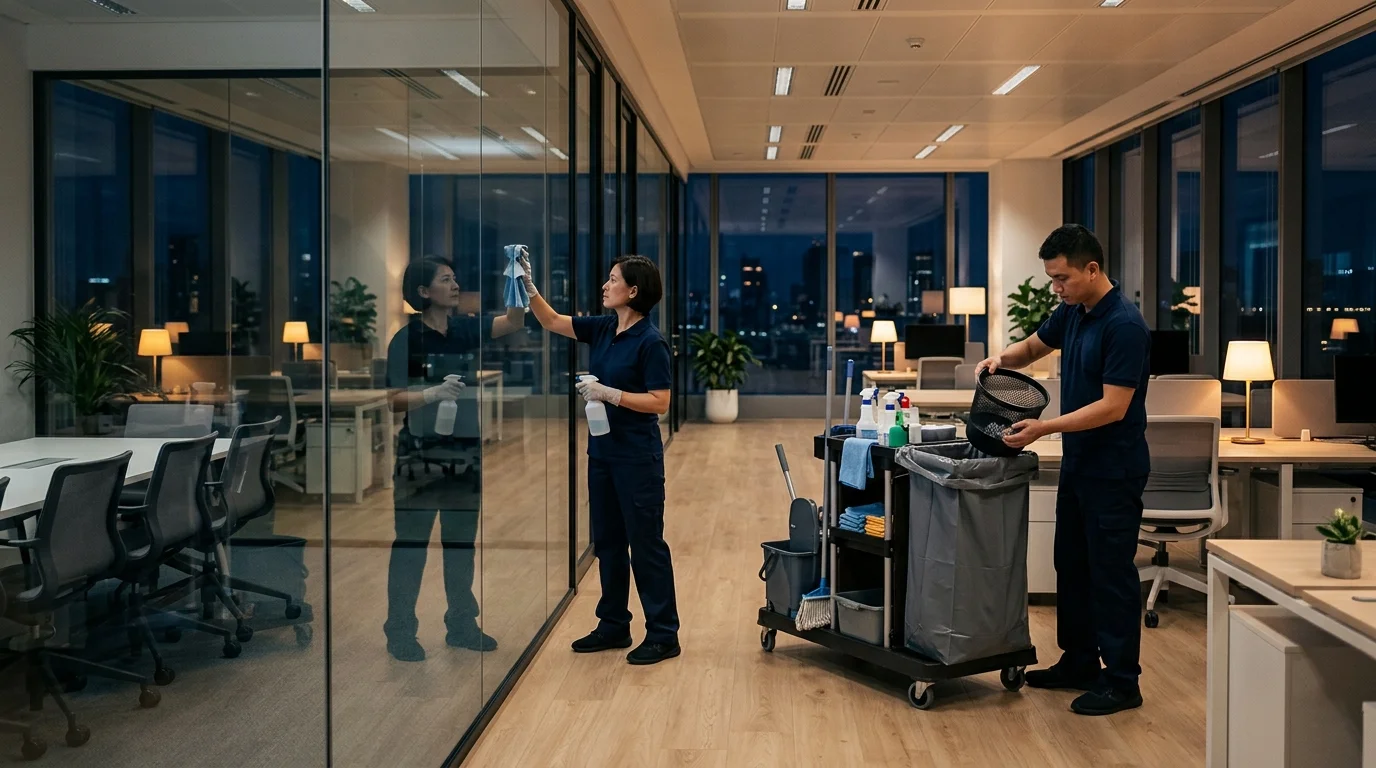
Most professional offices in the Gainesville and Lake Lanier area run their cleaning after hours.
The reasons are obvious: cleaning during business hours interrupts work, creates noise, blocks hallways, and forces staff to move out of the way constantly.
What is less obvious is everything that goes into making after-hours cleaning actually work — the access protocols, alarm coordination, insurance considerations, and the trust framework that has to be in place before anyone with a cleaning kit can let themselves into your office at 9 p.m.
After 20+ years cleaning offices around North Georgia, I can tell you the businesses with smooth after-hours operations all built specific systems early.
The businesses that struggle with cleaning typically have ad-hoc access arrangements that gradually decay into security gaps.
This guide walks through how to set up after-hours office cleaning correctly: the access protocols, the alarm coordination, the vetting standards, the insurance considerations, and the practical scheduling decisions.
For broader context, see our complete guide to commercial cleaning in Gainesville.
Why After-Hours Cleaning Wins
Three operational realities make after-hours the standard for most professional offices.
No interruption to work. A cleaner moving through occupied office space slows everyone down — phone calls get muted, conversations pause, paths get blocked. After-hours cleaning eliminates the friction entirely.
Better cleaning quality. A cleaner with full access to unoccupied space cleans faster and more thoroughly. Desks can be wiped without moving around someone working at them. Floors can be mopped without skipping occupied areas. Restrooms can be deep-cleaned without coordination.
Lower lighting and HVAC requirements. Many offices reduce HVAC and lighting after hours, which slightly lowers the cost of running the cleaning visit if utilities are billed separately.
The trade-off is that after-hours cleaning requires a more developed access and trust framework than daytime cleaning.
Access Protocols: The Three Models
Every after-hours cleaning arrangement uses one of three access models.
Model 1: Shared key
The cleaning service is given a physical key to the office.
Pros:
- Simple, no technology dependencies
- Works for any building
- No access logs but no electronic failure modes
Cons:
- Lost or copied keys are a security risk
- No record of who accessed when
- Re-keying is expensive when staff or vendors change
This model is fine for small offices with stable, long-term cleaning relationships.
Model 2: Lockbox or shared code
The cleaning service knows a code that gives them access through an electronic lock or accesses a key in a lockbox.
Pros:
- Code can be changed without re-keying
- No physical key in the cleaner’s possession
- Easy to rotate access among multiple authorized people
Cons:
- Codes can be shared (intentionally or accidentally)
- No record of access
- Electronic lock failures lock the cleaner out
This is the most common model for medium-size offices.
Model 3: Individual electronic access
Each authorized cleaner has their own credential — a key fob, a card, an app code, or biometric access.
Pros:
- Full access logs (who came in, when, how long)
- Credentials can be revoked individually
- Strongest security model
- Often integrates with alarm system
Cons:
- Requires modern access control system
- More setup work for new crew members
- Higher cost for the building owner if they manage the system
This is the standard for larger offices, regulated industries, and any office with sensitive data exposure.
Alarm System Coordination
Office alarm systems and after-hours cleaning have to be coordinated explicitly.
A cleaner who triggers a false alarm at 10 p.m. costs you the false alarm fine, the response time of police, and likely a strained relationship with your alarm monitoring company.
Three alarm coordination models work.
Model A: Cleaner has alarm code
The cleaner disarms the alarm on arrival and rearms on departure.
This is the simplest model and works well when:
- The cleaning team is small and stable
- The alarm code is dedicated to the cleaner (not shared with the master code)
- The alarm system supports user-specific codes
Model B: Designated office contact arms/disarms
A specific staff person disarms the alarm before the cleaner arrives and arms it after they leave.
This works when:
- The cleaning visit is at a consistent time
- The designated contact is available reliably
- You want to keep all alarm codes internal
The downside is the dependency — if the contact is unavailable, the cleaner cannot enter.
Model C: Monitored entry with verification
The alarm company calls a designated contact to verify that the after-hours entry was authorized.
This adds friction but provides the strongest verification model.
Common in regulated industries (legal, medical, financial).
What to Set Up With Your Alarm Company
Before any after-hours cleaning starts, set up these items with your alarm monitoring company.
- A user-specific code for the cleaner (not the master code)
- A schedule of expected after-hours entry windows
- A primary contact for verification calls
- A secondary contact when primary is unavailable
- Clear protocol for what happens if the cleaner is locked out
Most monitored alarm systems can flag entries outside expected windows for review.
This is exactly the kind of audit trail you want.
Trust and Vetting: Background Check Standards
Anyone who has unsupervised after-hours access to your office should be vetted at a higher standard than a typical service vendor.
What “fully vetted” should mean for after-hours cleaning crew:
- Criminal background check — at minimum, county-level for the cleaner’s residential history; ideally national database
- Employment verification — confirmation that the cleaning service actually employs the worker (not a subcontractor)
- Reference verification — references from prior commercial clients
- Identity verification — government-issued ID confirmed
- Bonding — the cleaning company should be bonded so theft is covered financially
- Insurance — general liability and workers’ comp
Ask the cleaning service for documentation of their vetting process.
A reputable service has a written process and can describe it without hesitation.
A vague answer (“we trust our team”) is the wrong answer for after-hours access.
For the broader vetting framework on choosing a commercial cleaner, see choosing a commercial cleaning company in North Georgia.
Insurance Considerations
Two insurance topics matter specifically for after-hours cleaning.
General liability and workers’ comp (the cleaner’s policies)
The cleaning service must carry:
- General liability insurance (covers damage to your property)
- Workers’ compensation (covers their employees’ injuries)
- Bonding (covers theft)
If the cleaner is injured in your office and they do not have workers’ comp, they could potentially sue your business directly.
Always verify coverage before granting after-hours access.
Your business insurance
Some commercial property insurance policies have specific provisions about after-hours vendor access.
Two things worth checking with your insurance broker:
- Whether the policy requires alarm system disclosure for vendor access
- Whether vendor theft is covered under your business policy or only under the vendor’s bond
Most modern commercial policies handle this without issue, but a quick call to your broker before setting up after-hours cleaning is worth the time.
Operational Scheduling Decisions
Once the access and trust framework is in place, the actual scheduling decisions matter.
Frequency
For a typical professional office (10-30 staff), the standard schedules are:
- 2-3 times per week — most common; balances cost and consistency
- 5 days per week (every business day) — for food-adjacent or high-traffic offices
- Weekly — for very small offices or low-traffic spaces
For more on choosing the right frequency, see our existing guide on how often your office should be professionally cleaned.
Time of visit
Most after-hours visits happen between 6 p.m. and 1 a.m.
The factors that influence the specific time:
- When the last staff member typically leaves
- What time the cleaner has to be elsewhere
- Whether your alarm company has a preferred entry window
- Whether the office is in a building with multiple tenants (coordinate with property management)
A consistent visit window (e.g., “between 8 p.m. and 10 p.m. on Mondays, Wednesdays, Fridays”) is much better than a flexible window.
It makes alarm coordination easier and creates clearer audit trails.
Day-of-week distribution
For a 3-day-per-week schedule, the distribution that works best is Monday, Wednesday, Friday — every other day prevents accumulation between visits.
For 2-day-per-week, Tuesday and Thursday or Monday and Thursday are common. Avoid stacking both visits on consecutive days; you lose the maintenance benefit.
For 5-day-per-week, Monday through Friday is standard, with a deeper visit on one day (often Friday so the office starts Monday at full clean baseline).
Late-Staying Employees
The biggest practical complication in after-hours cleaning is late-staying employees.
If your office has staff who routinely stay past 7 p.m., the cleaning team has to coordinate around them.
Three approaches work.
Approach 1: Set a “cleaning starts at” time
Communicate clearly to staff: “Cleaning crew arrives at 8 p.m. nightly. Please be wrapping up by then.”
This works in office cultures where staff respect the boundary.
Approach 2: Cleaner works around late stayers
The crew cleans common areas and unoccupied offices first, leaving occupied spaces for last.
This works when there is enough common-area work to stay productive while waiting.
Approach 3: Push cleaning later
Schedule the cleaning to start at 9 or 10 p.m., after almost everyone is gone.
This works for offices with consistent late staying but raises the cost slightly (cleaners typically charge a premium for late shifts).
What to Provide Your After-Hours Cleaner
A short setup briefing covers everything they need.
- Building access details (key, code, entry instructions)
- Alarm code and arm/disarm procedure
- Specific entry door (some buildings have multiple)
- Light switch locations for the entry sequence
- Restroom and supply closet locations
- Any rooms that should not be entered (server rooms, executive offices)
- Trash disposal location (interior bin vs. dumpster)
- How to lock up and confirm the office is secure on departure
- Emergency contact for any issues during the visit
- How and when to communicate completion (text, email, work-order app)
Many cleaning services have a standardized intake form for after-hours setups.
If yours does not, write your own and have it signed by both parties.
Communication and Issue Reporting
A good after-hours cleaning relationship has a clear channel for routine communication and a separate channel for issues.
Routine communication
A short text or app message after each visit confirming:
- Visit started at [time]
- Visit completed at [time]
- Nothing unusual observed
- Or: specific items noted
Issue reporting
For anything outside routine — a leak discovered, a piece of office equipment damaged, evidence of unauthorized entry, supplies depleted unexpectedly — a separate clear protocol.
A photo plus a brief description sent to your designated contact within an hour of discovery.
This kind of structured communication prevents small issues from becoming surprises.
Cost Implications of After-Hours Cleaning
After-hours cleaning typically costs 5-15 percent more than the same scope of work during business hours.
The premium reflects:
- Crew availability (after-hours work is less attractive to many cleaners)
- Coordination overhead (alarm, access, late stayers)
- Higher liability exposure (no client staff present)
- Light premium for night shift work
For most professional offices, this premium is worth paying.
The productivity gain from not having a cleaner working around your staff usually exceeds the additional cost.
For more detailed pricing context on commercial work, see how often should your office be professionally cleaned.
When After-Hours Does Not Work
A few situations where after-hours cleaning is not the right approach.
Highly secure environments
Some regulated industries (defense, certain financial, certain medical) require constant supervision of any vendor in the space.
After-hours unsupervised access does not meet the standard.
In these environments, in-business-hours cleaning with continuous escort is sometimes required.
Buildings with strict after-hours policies
Some office buildings (especially in larger metro areas) have building-management restrictions on after-hours access that complicate the model.
Very small offices
For a 1-3 person office, the overhead of setting up after-hours access often is not worth it.
A weekly daytime visit timed for low-traffic windows often makes more sense.
The Bottom Line
After-hours office cleaning is the standard for a reason — it produces better cleaning quality with less interruption to your staff.
It requires more setup than daytime cleaning: access protocols, alarm coordination, vetting, and insurance verification.
Once the setup is right, the operational rhythm is reliable for years.
If you would like to talk through what an after-hours cleaning schedule would look like for your Gainesville-area office, request a free quote.
We work with professional offices, retail spaces, and small businesses across the Lake Lanier region — and we will walk through the access and scheduling details specifically for your space. (Running a storefront? See our retail cleaning checklist for a complete daily/weekly/monthly breakdown.)