

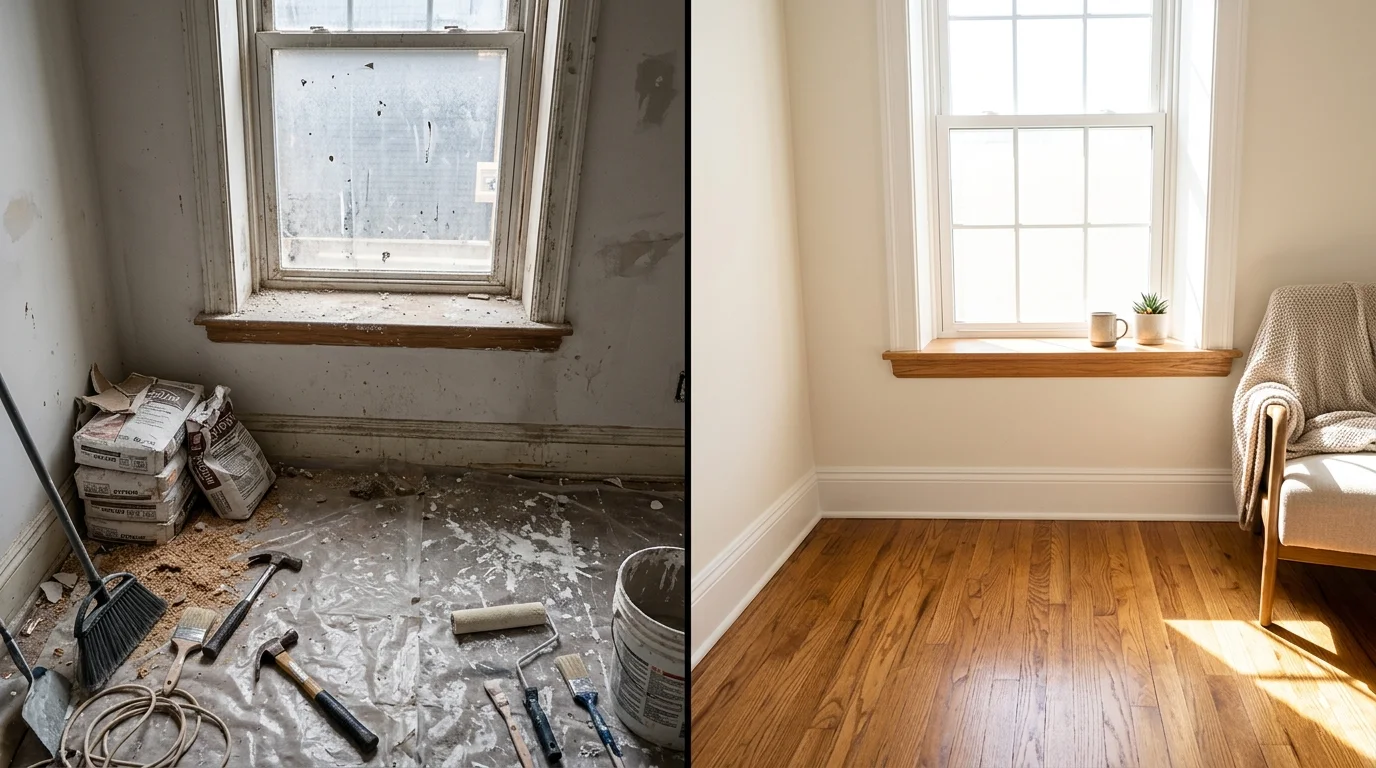
The most common misunderstanding I hear after a renovation is “we just need a deep clean before we move in.”
A deep clean and a post-construction clean are different services.
A deep clean cannot do a post-construction job, and a post-construction clean is overkill (and overpriced) if you actually only need a deep clean.
After 20+ years cleaning homes in North Georgia — including dozens of post-renovation cleanups across Gainesville, Cumming, and Lake Lanier — I can tell you the cost of getting this wrong is real.
Hire deep cleaning for what is actually a post-construction job and you will end up needing the post-construction clean anyway, paying twice.
Hire post-construction cleaning for what is actually a deep clean and you will overpay by 40-60 percent for capabilities you do not need.
This guide explains the difference clearly so you can hire the right service the first time.
For broader context, see our complete guide to property transition cleaning.
What Each Service Actually Tackles
The two services solve different problems with different tools.
Deep Cleaning
A deep clean is a comprehensive reset of a normally-lived-in home.
It addresses the buildup that accumulates over months of regular use — grease in the kitchen, soap scum in the bathroom, dust on the ceiling fans, grime on the baseboards.
The home was already livable before the deep clean.
The deep clean restores it to a “freshly cleaned” baseline.
Typical scope:
- All standard cleaning tasks plus depth (inside appliances, baseboards, ceiling fans)
- Hand-washing of vertical surfaces
- Detail work on grout, blinds, window tracks
- HVAC vent register cleaning
- Often includes some upholstery or area rug treatment
Equipment used:
- Standard professional vacuums (HEPA preferred but not always required)
- Microfiber, brushes, scrub pads
- Standard cleaning products plus some specialty (degreasers, descalers)
Typical duration: 4-8 hours for a 2,500 square foot home.
Typical cost: $315-$345 for the same home.
Post-Construction Cleaning
Post-construction cleaning is a specialty service that addresses the very specific aftermath of building or renovation work.
The problem is not normal household buildup.
The problem is fine drywall dust, paint splatter, adhesive residue, sawdust, plaster dust, and construction debris.
These materials behave differently than household dust.
Drywall dust in particular is a fine, talcum-like powder that gets into HVAC systems, electronics, soft surfaces, inside cabinets and drawers, and on top of ceiling fan blades.
Standard vacuums spread it around rather than capturing it.
A regular cleaning crew without HEPA equipment will leave a haze of fine dust that recoats every surface within hours of “cleaning.”
Typical scope:
- Three-pass approach: debris removal → fine dust capture → detail and finish
- Removal of contractor protective coverings, tape, and stickers
- Drywall dust removal from every surface, including inside cabinets, on light fixtures, and on top of door frames
- Paint splatter and adhesive residue removal from floors and fixtures
- Window cleaning including stickers and tape residue
- HVAC system protection during cleaning (filter changes after)
- Cabinet interior wiping (every shelf, every drawer)
- Often includes glass surface treatment and final polish
Equipment used:
- HEPA-filtered vacuums — not optional; standard vacuums spread drywall dust
- Tack cloths — for fine dust on flat surfaces that microfiber misses
- Specialty solvents — for adhesive, paint, and caulk residue
- Razor scrapers — for paint splatter on tile, glass, and hard floors
- Heavy-duty wet/dry vacuums — for debris and standing material
Typical duration: 8-16 hours for a 2,500 square foot post-renovation home.
Typical cost: $525-$580 for the same home.
The Drywall Dust Problem (Why It Matters)
Most people underestimate how invasive drywall dust is.
A few specific properties make it uniquely difficult to remove.
Particle size — drywall dust particles are 1-10 microns. For comparison, household dust is 50-100 microns. The fine particles bypass standard vacuum filters and recirculate through the air, settling back onto surfaces minutes after being disturbed.
Static cling — drywall dust carries a slight electrostatic charge that makes it adhere to vertical surfaces (walls, cabinet sides, electronics) more aggressively than household dust.
Persistence — drywall dust released into a forced-air HVAC system will continue to redeposit on surfaces for weeks if not properly captured at source.
Health considerations — fine drywall dust contains crystalline silica and other respiratory irritants. OSHA regulates exposure for construction workers; homeowners moving back in to an inadequately cleaned post-renovation home can experience respiratory symptoms.
This is why the post-construction process requires HEPA filtration at every stage and a multi-pass approach — single-pass cleaning leaves enough particles airborne to recontaminate every surface.
The Equipment Difference
The hardware separates the two services more than the chemistry does.
| Equipment | Deep Clean | Post-Construction |
|---|---|---|
| HEPA-filtered vacuum | Preferred | Required |
| Tack cloths | Not used | Required |
| Razor scrapers | Occasional | Required |
| Adhesive solvents | Not used | Required |
| Wet/dry shop vacuum | Not used | Required |
| Drop cloths during work | Not used | Often required |
| Air scrubber / HEPA air filter unit | Not used | Sometimes used |
| Disposable filters and bags | Standard | High-volume |
A cleaning crew that arrives at a post-renovation job with the deep-clean toolkit cannot complete the work properly.
This is one reason why a “we’ll just do a deep clean” approach to post-renovation work consistently fails.
When You Need Each Service
The clearest way to decide is to look at what created the mess.
You need a deep clean when:
- The home has been lived in normally for 3+ months without a deep clean
- You are preparing for guests or hosting an event
- You are listing a home for sale (see pre-listing deep clean checklist)
- Spring or fall reset cleaning
- First professional clean before starting recurring service
- You moved into a previously-occupied home and want to refresh it
You need post-construction cleaning when:
- Any drywall, painting, or texture work was done
- New flooring was installed
- Cabinets were installed or refinished
- Walls were demolished or built
- A new bathroom or kitchen was added
- Any contractor used the phrase “broom cleaned” at the end of the job
- You can see fine dust on horizontal surfaces a day after contractors left
You may need both when:
- You renovated part of the home before listing it for sale
- You renovated before moving into a home (post-construction first, then move-in deep clean)
- You added a major addition (post-construction in the new section, deep clean of the original sections to remove dust that traveled)
For more on combining services around a property transition, see coordinating cleaning around your moving day.
What “Broom Cleaned” Actually Means
If your general contractor delivered the project as “broom cleaned,” that means:
- Large debris and material has been swept up
- Tools and equipment have been removed
- The space is structurally complete
- The HVAC vents may or may not have been re-installed
It does not mean:
- The space is dust-free
- Surfaces are wipe-clean
- The HVAC system is clear of construction dust
- The home is move-in ready
Almost every renovation needs a post-construction clean after the contractor’s broom-clean handoff.
This is industry standard, not a sign your contractor cut corners.
Pricing Comparison
For a 2,500 square foot home in the Gainesville / Lake Lanier area:
| Service | Typical Range | Duration |
|---|---|---|
| Deep clean | $315-$345 | 4-8 hours |
| Post-construction clean | $525-$580 | 8-16 hours |
| Post-construction + deep clean (combined visit) | Quoted after a walkthrough | 12-20 hours |
Why post-construction costs roughly twice as much:
- More labor hours per square foot
- Specialty equipment and consumables
- Disposable supplies (HEPA filters, tack cloths, scraper blades)
- Higher physical demand on the crew
- Liability exposure from working in active construction environments
A bid that comes in at “deep clean” prices for a post-construction job means the cleaner is either underestimating the scope or planning to do a lighter version of post-construction work.
Either way, you will likely end up paying for a re-clean.
Timing Recommendations
When to schedule each service relative to your project.
Post-construction
- Schedule 3-7 days after the contractor’s final sign-off
- Do not schedule sooner — there is almost always a punch-list item the contractor needs to come back for, and another round of dust will follow
- Do not schedule later — drywall dust continues to settle into HVAC and electronics over time
- If you are moving into the home immediately, time the post-construction clean to finish 24-48 hours before your move-in date
Move-in deep clean (after post-construction)
- Some homeowners want a “move-in fresh” deep clean after the post-construction work, particularly for major renovations
- This is optional — a thorough post-construction clean usually leaves the home in better condition than a typical move-in deep clean
- If you are doing both, the deep clean should happen 1-3 days after the post-construction clean and 1 day before move-in
Pre-listing deep clean (after partial renovation)
- If you renovated to prepare for sale, the post-construction clean handles the renovated areas
- The pre-listing deep clean handles the rest of the home and any drywall dust that traveled into other rooms
How to Hire the Right Service
Three questions separate cleaners who can actually do post-construction work from cleaners who claim they can.
1. Do you use HEPA-filtered vacuums for post-construction work?
A correct answer specifies the equipment by name and confirms HEPA filtration.
Vague answers (“yes, we have good vacuums”) usually mean no.
2. What is your three-pass process?
A correct answer describes debris removal first, fine dust capture second, and detail / finish third.
If the answer is one undifferentiated “we’ll clean everything,” the cleaner is not differentiating post-construction from regular cleaning.
3. Do you handle adhesive, paint splatter, and tape residue?
A correct answer specifies the products and tools used (specific solvents, razor scrapers, technique for fragile surfaces).
A vague “we’ll figure it out” usually means damage to the new finishes you just paid for.
For the broader vetting framework, see our guide on choosing a commercial cleaning company in North Georgia — many of the same principles apply to specialty residential cleaning.
The Bottom Line
Deep cleaning and post-construction cleaning solve different problems, use different equipment, and cost different amounts.
If you have done any drywall, painting, flooring, or cabinet work in the last 30 days, you need post-construction cleaning — not a deep clean.
If your home has been normally occupied without major work, you need a deep clean — not post-construction.
Hire the wrong service and you will pay for the right one anyway.
If you are not sure which one your situation calls for, request a free quote and we will tell you honestly which service fits — including telling you when you only need a deep clean and could save the money.