

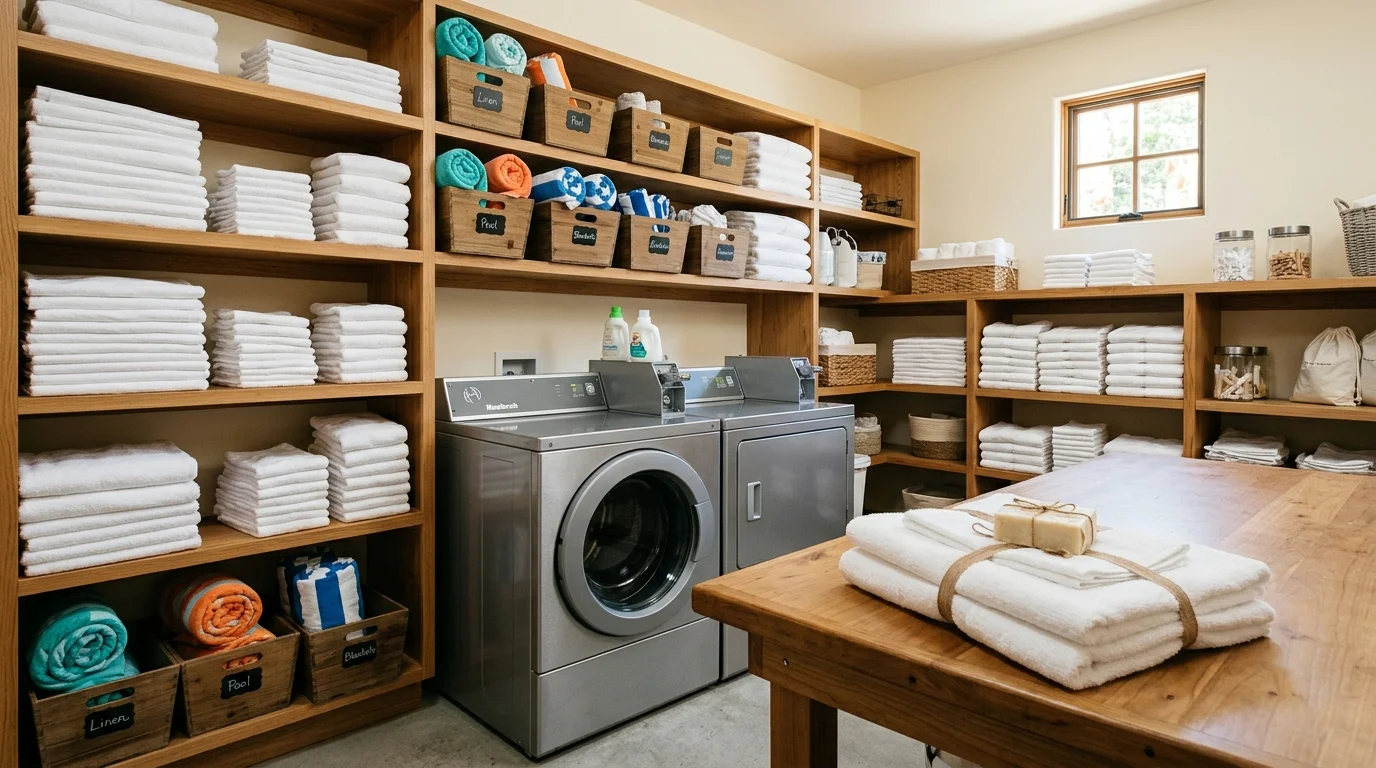
Linens are the single biggest operational variable in a vacation rental.
They are the bottleneck on turnover speed.
They are a meaningful chunk of annual operating cost.
They are the most common source of guest complaints when something goes wrong.
And they are the one piece of the operation most new hosts underinvest in.
After 20+ years cleaning vacation rentals around North Georgia, I have seen the full range — properties with two pillowcases and a single set of towels, properties with a commercial laundry service, properties with three full sets per bed and a dedicated linen closet that looks like a hotel.
This guide walks through the strategic decisions: how much to own, where to launder, what to charge for replacement, and the math that makes each option work or not.
For the broader operational context, see our complete guide to vacation rental cleaning on Lake Lanier.
The Core Decision: Own vs. Rent
Two basic models exist for vacation rental linens.
Own Your Linens
You buy the sheets, towels, and bedding. You launder them yourself or pay your cleaning crew to launder.
Pros:
- Full control over quality, brand, and feel
- Lower per-turn cost after initial investment
- No delivery dependency
- Better margins long-term
Cons:
- Significant upfront investment
- You absorb replacement costs as items wear out
- Laundry is a real time cost (yours or your cleaner’s)
- Storage space required
Rent from a Linen Service
A commercial linen service delivers fresh linens before each turnover and picks up the dirty ones afterward.
Pros:
- No laundry burden
- Predictable per-turn cost
- Always uniform quality
- No replacement budgeting
Cons:
- Higher per-turn cost
- Delivery scheduling can fail during peak weeks
- Less control over feel and quality
- Limited service area in some parts of North Georgia
For most Lake Lanier hosts, owning makes more financial sense above 30 nights per year of bookings.
Below that threshold, the linen service may pencil out.
Par Levels: How Much to Actually Own
The professional standard for vacation rentals is 3 par — three complete sets per bed and per bath.
Here is why three.
- Set 1: On the bed / in use
- Set 2: Clean and ready in storage
- Set 3: In the laundry cycle (washing, drying, or being folded)
This rotation prevents same-day turnover from collapsing if a load takes longer than expected, if linens are damaged and need replacement, or if back-to-back turns leave no buffer for laundry.
For a 3-bedroom, 2-bath lake house with one queen and two king beds, a 3-par inventory looks like:
| Item | Per Set | Total (3 par) |
|---|---|---|
| Queen sheets (fitted, flat, 2 pillowcases) | 1 set | 3 sets |
| King sheets (fitted, flat, 2 pillowcases) | 2 sets | 6 sets |
| Bath towels | 6 | 18 |
| Hand towels | 4 | 12 |
| Washcloths | 6 | 18 |
| Bath mats | 2 | 6 |
| Beach/pool towels | 8 | 24 |
Beach towels deserve a special note for Lake Lanier rentals — they are the highest-volume linen in any lake property and are also the most likely to disappear (see “Replacement and Theft” below).
What to Buy: Quality Standards
Hotel-quality linens are designed for institutional laundering — repeated hot washes, commercial detergents, and high-volume use.
Consumer linens are not, and they fall apart in 6 months of vacation rental use.
Sheets
- Fabric: 100% cotton percale or sateen, 200-400 thread count
- Avoid: anything labeled “microfiber” (does not breathe, generates pills) or extremely high thread counts (often misleading)
- Color: white, always — bleachable, easy to spot stains, signals freshness
- Brand tier: Standard Textile, Riegel, or comparable hospitality suppliers; consumer brands like Brooklinen are not built for this volume
Towels
- Weight: 600-700 GSM bath towels for guest-facing; 500 GSM for pool/beach
- Color: white for indoor, colored is acceptable for pool/beach
- Avoid: novelty patterns, monogrammed (steal-able), extremely thick towels (do not dry in time for same-day turns)
Bedding
- Duvet covers rather than comforters — they wash, comforters mostly cannot
- White, again — bleach-able, always looks fresh, signals cleanliness
- Mattress protectors and pillow protectors under every sheet — extends mattress life from 5 years to 10+ and protects against bedbug claims
The total upfront investment for a 3-bedroom lake house at full 3-par hospitality-grade inventory is roughly $2,500 to $4,000.
That sounds steep until you compare it to renting linens at $30 to $50 per turnover across 30+ turns a year.
Stain Protocol
Stains are inevitable.
How you handle them determines whether linens last 18 months or 5 years.
The standard protocol
- Pre-treat immediately at turnover — apply enzymatic stain remover to any visible stain before the linen goes into the wash
- Wash hot — 140°F+ for sanitization and stain removal
- Bleach with non-chlorine oxygen bleach — chlorine bleach destroys cotton fibers over time; oxygen bleach maintains whiteness without breaking down fabric
- Inspect post-wash — if a stain remains, repeat treatment before drying; heat sets stains permanently
- Retire damaged linens — anything torn, stained beyond recovery, or visibly worn goes to “shop rag” duty, not back into rotation
What to do with damaged linens
Tag them and remove from inventory.
Do not put a stained pillowcase on a bed because “it will probably be fine.”
A guest will notice, and a one-line review about a stained pillowcase costs more than a $12 replacement pillowcase.
On-Site vs. Off-Site Laundry
For owner-operators, the next decision is where the laundry happens.
On-site
The crew launders during turnover or you launder between guests.
Works when:
- Property has commercial-grade machines (extended capacity, faster cycles)
- Property is small enough that a single load handles all sheets
- Cleaning crew has adequate downtime to monitor loads
- Local water quality supports machine longevity (Lake Lanier area has hard water — water softener helps)
Off-site (cleaner takes home or commercial laundry)
The crew strips and bags dirty linens, takes them home or to a commercial wash, and returns them clean.
Works when:
- Cleaner has capacity at home for industrial-volume laundry
- Three-par inventory exists so on-site machines do not bottleneck same-day turns
- You build the laundry cost into the cleaning fee
For our vacation rental clients we work with what the house holds: when a fresh host set is on hand we swap it in, and otherwise we wash the linens on site — which is why a multi-set par matters so much on a tight window.
For more on managing tight turnover windows, see same-day Airbnb turnover on Lake Lanier.
Replacement and Theft
A vacation rental loses about 10-15 percent of its bath linen inventory per year to wear plus theft.
Beach towels lose closer to 25-30 percent annually — guests genuinely think they are included.
Budget accordingly.
| Item | Annual Loss Rate | Budget Per 3-Bedroom Property |
|---|---|---|
| Bath towels | 10-15% | $200-300/year |
| Beach towels | 25-30% | $300-400/year |
| Sheets | 5-10% | $150-250/year |
| Hand towels & washcloths | 15-20% | $50-100/year |
| Bath mats | 25-30% | $50-75/year |
Total annual replacement budget for a typical 3-bedroom lake property: $750 to $1,200.
Should you charge guests for missing linens?
In most cases, no.
A guest dispute over a $14 beach towel costs you reviews and platform standing.
Build the replacement cost into your cleaning fee or nightly rate and treat it as an operating expense.
The exception: bedding, robes, or anything clearly listed as “do not remove” in your house manual. For these, a clear charge is reasonable and platform-supported.
For a fuller breakdown of how to set the cleaning fee guests pay, see our companion guide on vacation rental cleaning fees.
Bedding Refresh Schedule
Even with perfect laundry protocols, linens have a useful life.
Plan for these refresh intervals:
- Sheets: replace at 18-24 months or when visibly worn
- Towels: replace at 12-18 months for bath, 6-12 months for pool/beach
- Pillows: replace every 12 months (allergens accumulate; guest complaints rise after year 1)
- Mattress protectors: replace every 24 months
- Mattresses: replace every 7-10 years (Airbnb guests notice mattress quality more than almost any other variable)
- Duvet inserts: replace every 24 months
Set a rolling refresh budget rather than waiting for visible failure.
A guest will notice a 14-month-old towel before you will.
The Welcome Touch
Done right, linens are a guest experience signal — not just an operational expense.
Two small touches make a disproportionate impression:
- A folded “welcome stack” on each bed — bath towel, hand towel, washcloth, neatly stacked, with a small soap or chocolate on top
- Spare set in the closet — visible on a shelf, signals that the host thought ahead
Cost: virtually zero.
Effect on reviews: meaningful.
This is the kind of detail that separates a 4.7-star rental from a 4.95-star rental.
For more on driving 5-star reviews specifically through cleaning quality, see vacation rental 5-star reviews and cleaning.
The Bottom Line
Linens are not a minor operational detail.
They are the single most touched, most photographed, and most reviewed element of a vacation rental.
For most Lake Lanier hosts above 30 nights of bookings per year:
- Own a 3-par inventory of hotel-grade white linens
- Use a competent stain and wash protocol
- Lean toward off-site laundry for same-day turn flexibility
- Budget $750-$1,200 annually for replacement
- Build losses into your cleaning fee, not into guest disputes
If you would like help thinking through linen logistics for your property — including which approach makes sense for your booking volume and crew arrangement — request a free quote and we will walk through it as part of your turnover plan.